

July 1, 2026 · 5 min read
What roof moss treatment leaves behind: zinc and copper vs. soft washing
Out here, whatever you put on your roof ends up in a salmon stream. Metal moss treatments add zinc and copper that never break down. Here's the difference that makes.
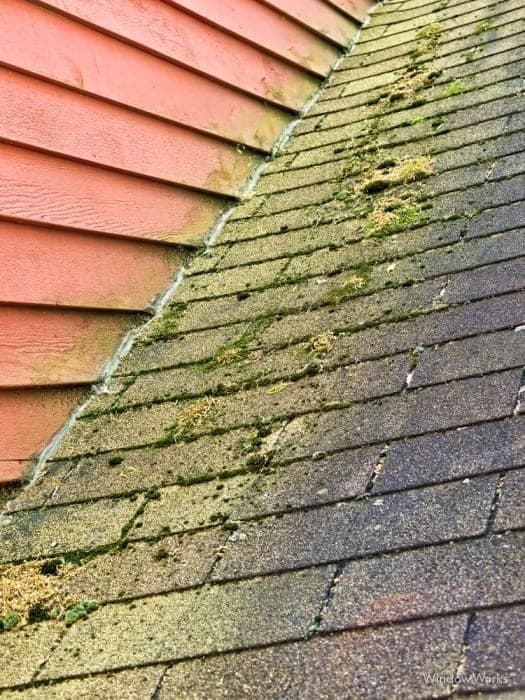
In western Washington, whatever you put on your roof ends up in the water. Rain sheets off the shingles, into the gutters, down the downspout, and into a storm drain, and in most of our area that drain runs straight to a creek, a lake, or Puget Sound with nothing treating it in between. So how you deal with roof moss is not only a roofing decision. It's a water-quality decision, in a place where the water still has salmon in it.
The catch with zinc and copper
Metal-based moss control, whether it's a zinc or copper strip along the ridge or a treatment that leaves metal behind, works by shedding those metals down the roof. They're toxic to moss and algae. The problem is that they're toxic to a great deal more than moss and algae.
Copper and zinc are near the top of the list of metals Washington's Department of Ecology tracks in stormwater, because they harm aquatic life at very low concentrations. In roof runoff they come off mostly in dissolved form, which is the form most readily taken up by living things.
Copper is especially hard on salmon. Research supported by NOAA and published in the journal Environmental Science & Technology found that copper at just a few micrograms per liter, a trace amount, dulls a juvenile salmon's sense of smell. That's the sense a young salmon uses to detect predators and find its way. Blunt it, and the fish is far more likely to be eaten before it ever reaches the ocean. In salmon country, that is not a minor side effect.
And metals don't break down. A metal is an element. There is no process that degrades it. Zinc and copper settle into stream sediment and accumulate, and every rainfall adds a little more. A treatment you reapply year after year keeps feeding the same water.
And the soaps wash off too
Zinc is not the only thing that ends up in the creek. Detergents and surfactants, the ingredients that make a cleaner foam and lift grime, are hard on aquatic life. University extension research shows they strip the protective mucus off fish and damage their gills, and they can kill fish eggs at low concentrations. When detergent-laden wash water runs off a roof or a driveway into a storm drain, it usually reaches a creek or a lake with no treatment in between.
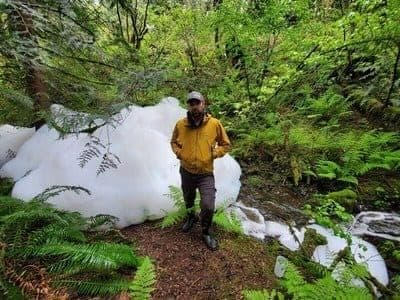
It is not hypothetical. In 2021, a townhome complex in Abbotsford, British Columbia, had about 100 kilograms of Tide laundry detergent spread across roughly 120 roofs to kill moss, a popular DIY shortcut. The next rain washed it into Clayburn Creek, a spawning stream for coho salmon and cutthroat trout, where it foamed as high as two and a half metres and ran as far as four kilometres. That is what a cheap moss remedy looks like a few hundred feet downhill.
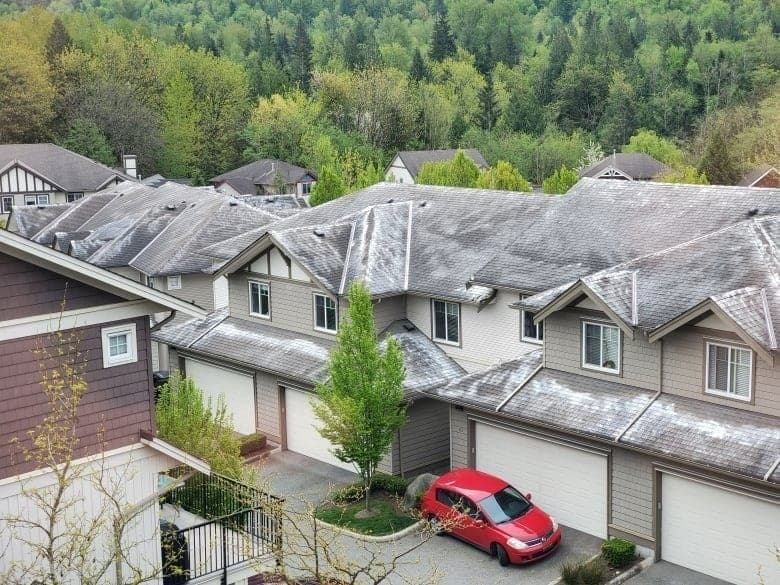
To be fair, not every foam on a creek is soap. Most foam on wild Northwest streams is natural, whipped up from the tannins and dissolved organic matter that decomposing leaves release. What made Clayburn Creek different was the source: bright, persistent foam that traced straight back to the detergent on the roofs uphill.
How soft washing compares
A soft wash uses a sodium hypochlorite solution, the same chlorine chemistry the Asphalt Roofing Manufacturers Association recommends as the most effective way to clean a roof. The important environmental difference is persistence. Hypochlorite is not a heavy metal. It doesn't build up in sediment or accumulate in fish. In the environment the hypochlorite ion degrades quickly, especially in sunlight and on contact with organic matter, breaking down rather than lingering. European and industry risk assessments describe it as neither persistent nor bioaccumulative.
We're not going to tell you bleach is nothing. Used carelessly it can burn plants and, at high concentration, harm aquatic life, and it can form byproducts as it reacts with organic matter. That is exactly why it's applied the way it is: diluted to the working strength the job actually needs, kept off your landscaping, and, on our Premium service, rinsed. Applied that way it does its work on the roof and then breaks down, instead of handing the watershed a metal that never leaves.
The same discipline applies to surfactants. Responsible exterior cleaning keeps the wash water off storm drains and out of the creek, dilutes to the strength the job needs, and leans on chemistry that breaks down rather than a heavy detergent load or a metal that stays in the sediment for good. A pile of laundry powder on the roof does the opposite of all three.
The method that lasts is also the one that leaves the least
There's a tidy symmetry here. The approach that protects your roof the longest is also the one that's easiest on the water. Zinc has to be redone, and it keeps shedding metal the whole time it's up there. A soft wash kills the moss, algae, and lichen at the root, so it lasts for years, and the chemistry that does it degrades instead of accumulating. You get the longer-lasting roof and the lighter footprint from the same choice.
If you want the full picture on the roof side, our roof washing page walks through how the soft wash works and what it protects. If you'd rather just talk it through, we're happy to take a look and give you an honest read. Get a free estimate online or give us a call.
Sources
- Washington State Department of Ecology, Copper and Zinc in Urban Runoff studies (apps.ecology.wa.gov)
- Sandahl et al., "A Sensory System at the Interface between Urban Stormwater Runoff and Salmon Survival," Environmental Science & Technology (2007); NOAA Fisheries copper-and-salmon olfaction research
- European Commission SCHER, Risk Assessment on Sodium Hypochlorite; GreenFacts summary on chlorine and sodium hypochlorite
- University of Florida IFAS Extension (SS720), on the aquatic toxicity of soaps and surfactants
- CBC News and Maclean's (2021), reporting on the Tide detergent moss treatment that foamed Clayburn Creek in Abbotsford, BC
- Oregon State University Extension, on the limits of zinc strips for roof moss
- Asphalt Roofing Manufacturers Association, algae and moss cleaning guidance (asphaltroofing.org)
See what it would cost.
Get a free estimate in minutes, or call and talk it through with a real person.