

September 1, 2026 · 4 min read
How much plastic does your laundry actually shed? The data
Counting the fibers one wash sends down the drain, what a year adds up to, where it all ends up, and the honest numbers on what a filter catches.
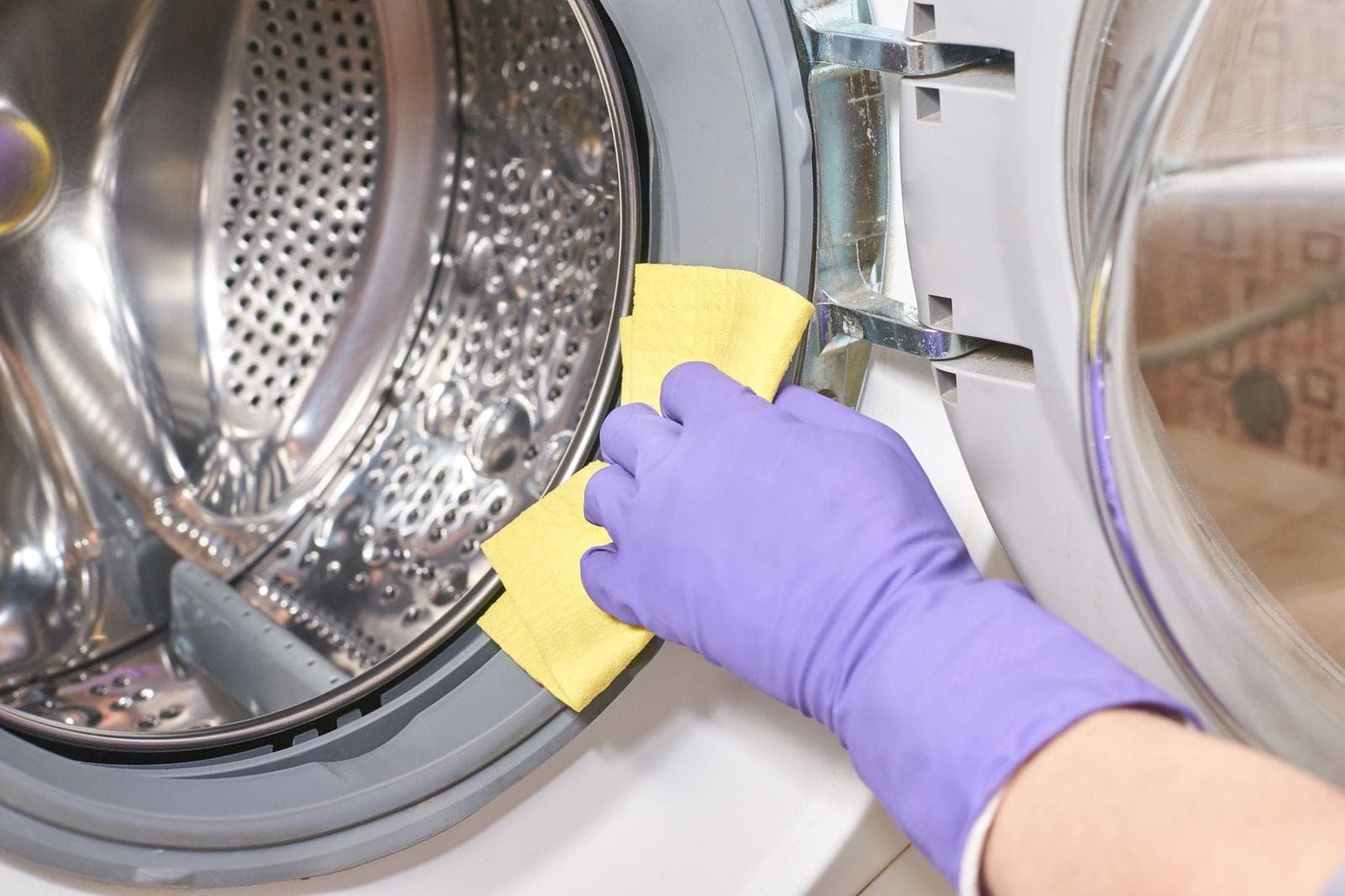
Most of a modern wardrobe is plastic. Fleece, activewear, swimwear, most sheets and towels, and the lining of almost every jacket are synthetic fiber, and every wash cycle shakes fragments of it loose and sends them down the drain. That makes the washing machine the biggest single source of microplastic fiber leaving an average house. The useful part is that this has been measured, repeatedly, and the numbers are specific.
What one wash releases
The benchmark study came out of the University of Plymouth, where researchers ran 6 kilogram loads of common fabrics through domestic machines and counted what came out the drain line. A polyester-cotton blend load released around 138,000 fibers. Pure polyester released around 496,000. Acrylic released nearly 730,000 fibers, from one load of laundry (Napper and Thompson, Marine Pollution Bulletin, 2016).
Those are per-wash numbers. A family running five loads a week is releasing fibers in the millions, every week, all year.
What a year adds up to
Fiber counts are hard to picture, so researchers at Ocean Wise weighed it instead: an average household in the US or Canada sends about 135 grams of microfiber down the drain per year (Vassilenko et al., PLOS ONE, 2021). Call it a third of a pound of loose plastic fiber, from one house, shed a few grams at a time by completely ordinary laundry.
Where it goes
Your drain does not run to Puget Sound untreated, and the treatment plant does its job well: plants typically remove more than 90 percent of microfibers, often well over 99. Two problems survive that percentage.
The first is volume. A study of one plant in Glasgow measured 98.4 percent removal, and the plant still discharged an estimated 65 million particles into the river every day, because 1.6 percent of an enormous number is still an enormous number.
The second is destination. The fibers a plant does catch are not destroyed. Between 63 and 80 percent settle into sewage sludge, which is processed into biosolids and spread on farmland, where the fibers remain.
The result shows up locally. In a 2025 survey of Puget Sound sediment, 73 percent of the microplastics found were fibers rather than fragments (Eshom-Arzadon et al., Journal of Marine Science and Engineering, 2025). Nothing downstream of your house was built to stop a fiber twelve microns wide.
What a filter actually catches
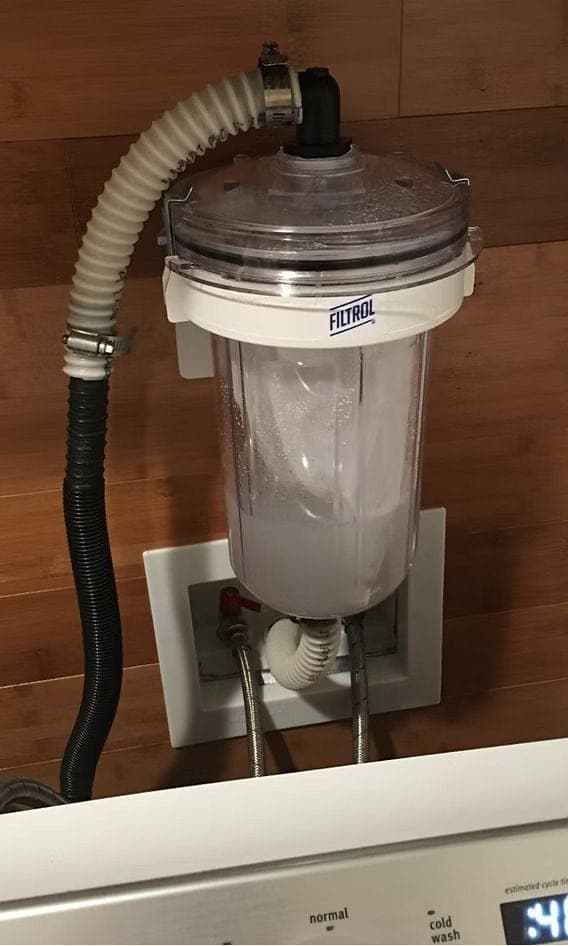
An inline laundry filter clamps onto the washer's discharge hose and catches fiber before it reaches the drain. Independent testing has measured capture anywhere from about 25 to 90 percent by weight, and anyone quoting you a single number has picked the test that flatters it. The high end is polyester through a fine mesh. Nylon has measured as low as 19 percent.
The bigger variable is maintenance. A full filter keeps draining but stops catching, and nothing looks or sounds wrong when that happens. That is why we sell the filter as a serviced install, emptied on a schedule, rather than a box of hardware.
What we install
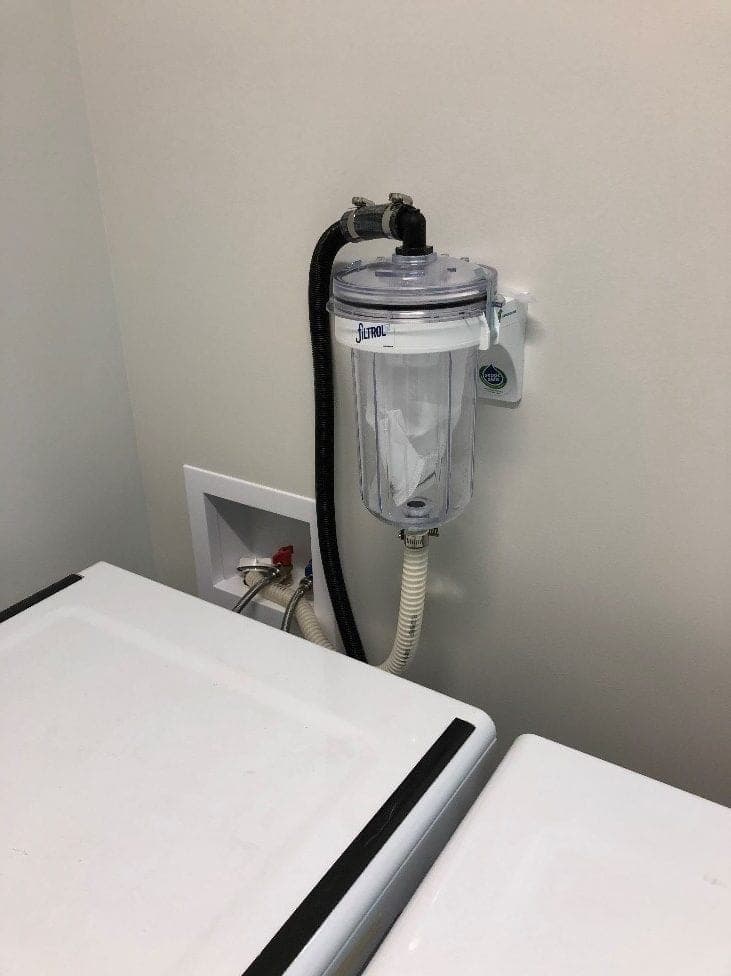
A 100 micron laundry filter that mounts on the wall beside the machine, made in the USA by Wexco of Milaca, Minnesota. No electricity, no batteries, no app. It clamps onto the discharge hose your machine already has, nothing gets cut, and it is rated to 25 gallons a minute, far above what a residential washer discharges, so the drain cycle does not slow down. We install it while we are already in your laundry room for a dryer vent cleaning, and we test a full drain cycle before we leave.
One honest caveat: not every laundry room takes one. You need roughly 8 inches of clear wall above the mounting point and a reachable standpipe, wall box, or laundry sink. In the largest field study of these filters, about one home in five could not be fitted. We check first, and there is no charge if yours will not take one.
What we will not claim
Microplastics have been found in human blood and tissue, but nobody has established that they harm people, and the World Health Organization found no apparent risk from microplastics in drinking water at current levels. You will find companies selling this exact filter on health claims anyway. We will not. Keeping a third of a pound of plastic fiber a year out of the water is reason enough.
The filter lives on our dryer vent service page, with the dimensions and the fit check:
See what it would cost.
Get a free estimate in minutes, or call and talk it through with a real person.