

November 18, 2026 · 6 min read
What You Should Never Pressure Wash, And What To Use Instead
Is It Safe To Power Wash A House? What The Makers Say
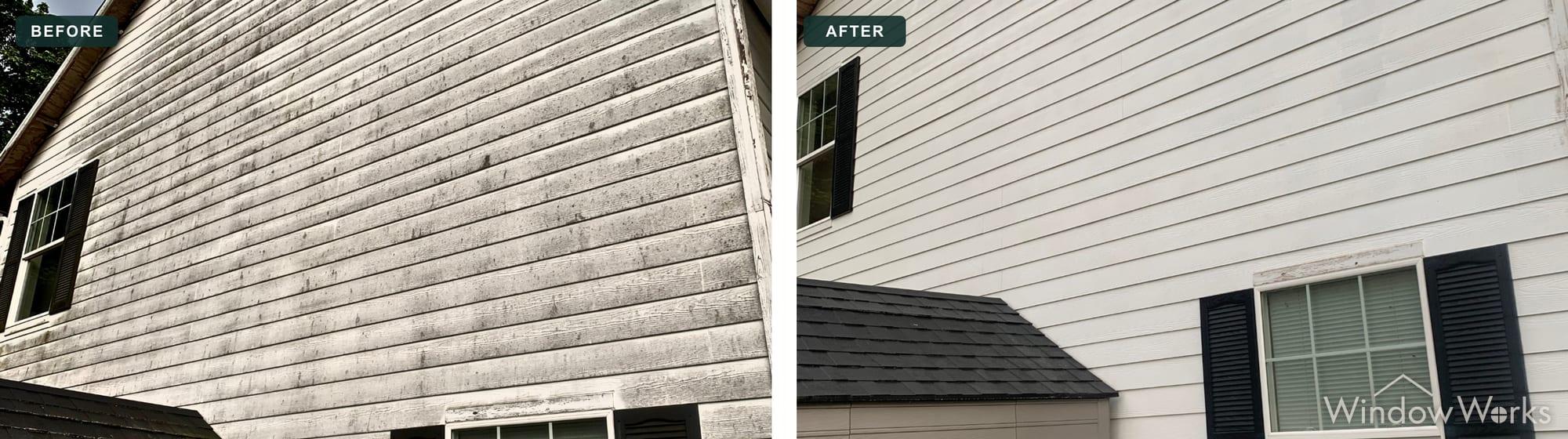
Is it safe to power wash a house? Not at high pressure. The companies that make shingles, windows, fiber cement siding and solar panels all say not to use a pressure washer on their products, and the vinyl siding and stucco makers set limits. The one surface around a house that a pressure washer is built for is concrete.
We did 361 washing jobs between January 2025 and November 2026. Of those, 301 included a soft wash, which is low pressure with a cleaner that does the work. We pressure washed on 108, on driveways, patios, walkways and entries, and 48 jobs got both on the same visit.
What Should You Never Pressure Wash?
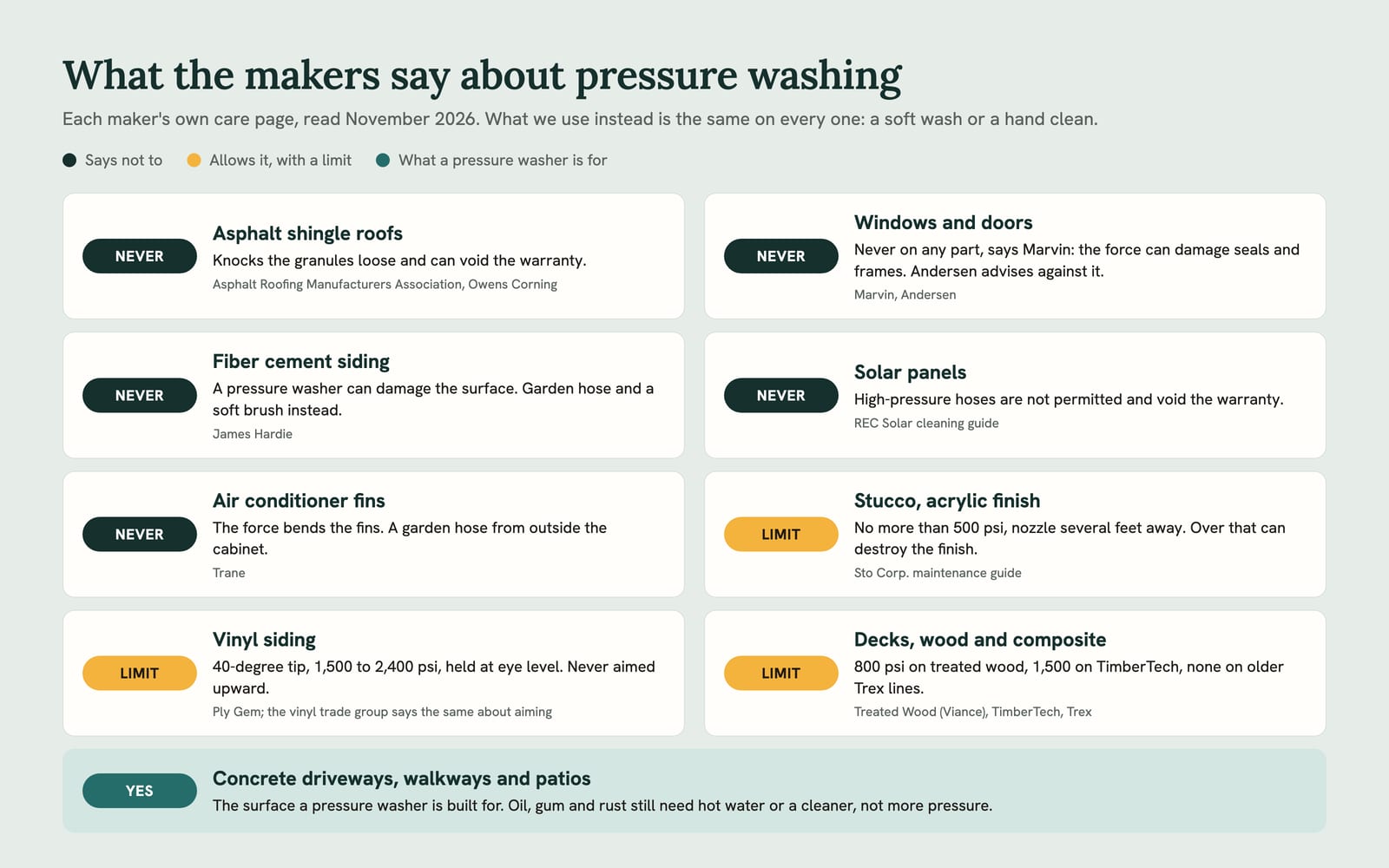
- Asphalt shingle roofs. Pressure knocks off the granules that protect the shingle.
- Windows and doors. The spray can damage the seals and frames.
- Fiber cement siding, like HardiePlank. James Hardie says a pressure washer can damage the surface.
- Solar panels. High pressure can damage the panel and void its warranty.
- Air conditioner fins. The spray bends them.
- Soft wood, like a cedar deck. Pressure tears up the surface of the wood.
Vinyl siding, stucco and most composite decks can take a pressure washer, but only within the limits their makers print.
Why Not The Roof?
The Asphalt Roofing Manufacturers Association, the shingle makers' trade group, says never to pressure wash an asphalt roof. It strips the granules and can lead to early roof failure. Owens Corning said the same in May 2026, adding that a pressure washer may void the shingle warranty, and it recommends a low-pressure soft wash.
That is how we clean every roof. The cleaner kills the moss and algae, and the rinse is gentle.
Is It Safe To Power Wash Siding?
Each siding maker sets its own rule, and some allow a pressure washer while others do not.
- Fiber cement, like HardiePlank. James Hardie says a pressure washer can damage the surface. It recommends a garden hose and a soft brush, once or twice a year.
- Vinyl. Ply Gem allows 1,500 to 2,400 psi with a 40 degree tip, held straight at eye level. It says never to aim the spray upward, because water collects behind the panels and can cause leaks, streaks and decay. The vinyl siding trade group says the same, and warns that some makers do not allow a pressure washer at all.
- Stucco. Sto, a stucco maker, says no more than 500 psi on its acrylic finishes, with the nozzle several feet from the wall. More than that can destroy the finish.
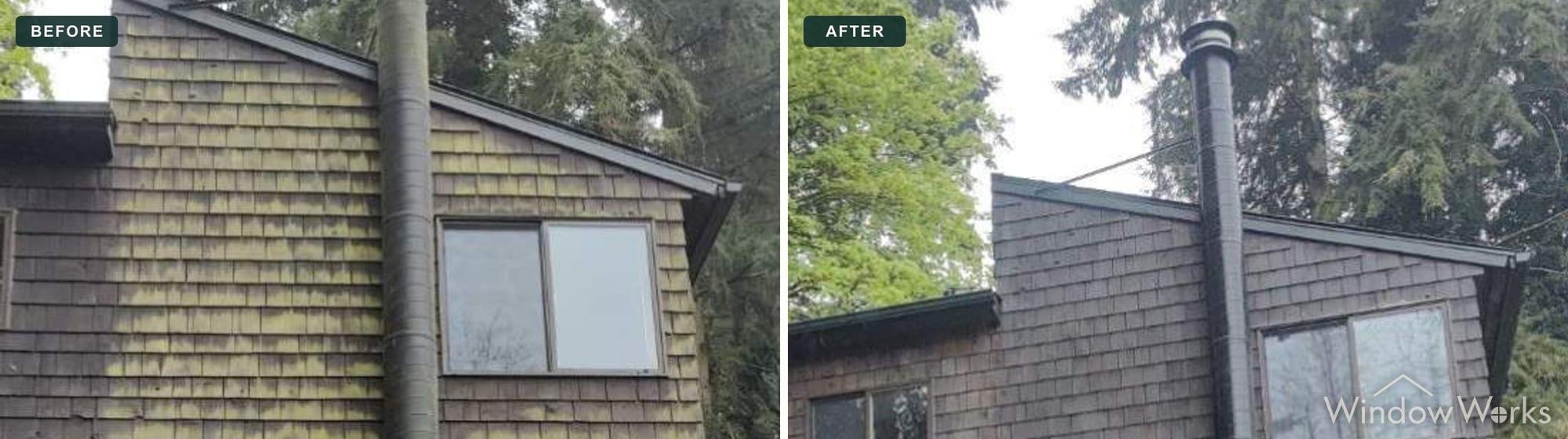
- Cedar and other wood. The USDA Forest Products Laboratory warns that power washing can strip wood off soft woods like western redcedar.
We soft wash every kind of siding at garden-hose pressure. The cleaner goes on from the bottom up, sits long enough to kill the algae and mildew, and rinses off from the top down. High pressure can force water behind the siding.
Why Not Windows And Doors?
Marvin, the window maker, says never to use a pressure washer on any part of a window or door, because the force can damage the seals, the glass and the frames. Andersen advises against it too. Its own advice is water with a little dish soap, or vinegar and water, a microfiber cloth and a squeegee.
On a house wash we close the windows and doors and check them before we start. A wash still spots the glass, so exterior window cleaning goes on every house wash estimate. You can take it off.
Why Not Solar Panels?
REC, a solar panel maker, does not permit high-pressure hoses on its panels. Its cleaning guide says the spray can damage the frame, the cells and the layers that seal them, and can push water between the glass and the frame. A pressure washer voids the warranty. A garden hose at normal household pressure is fine.
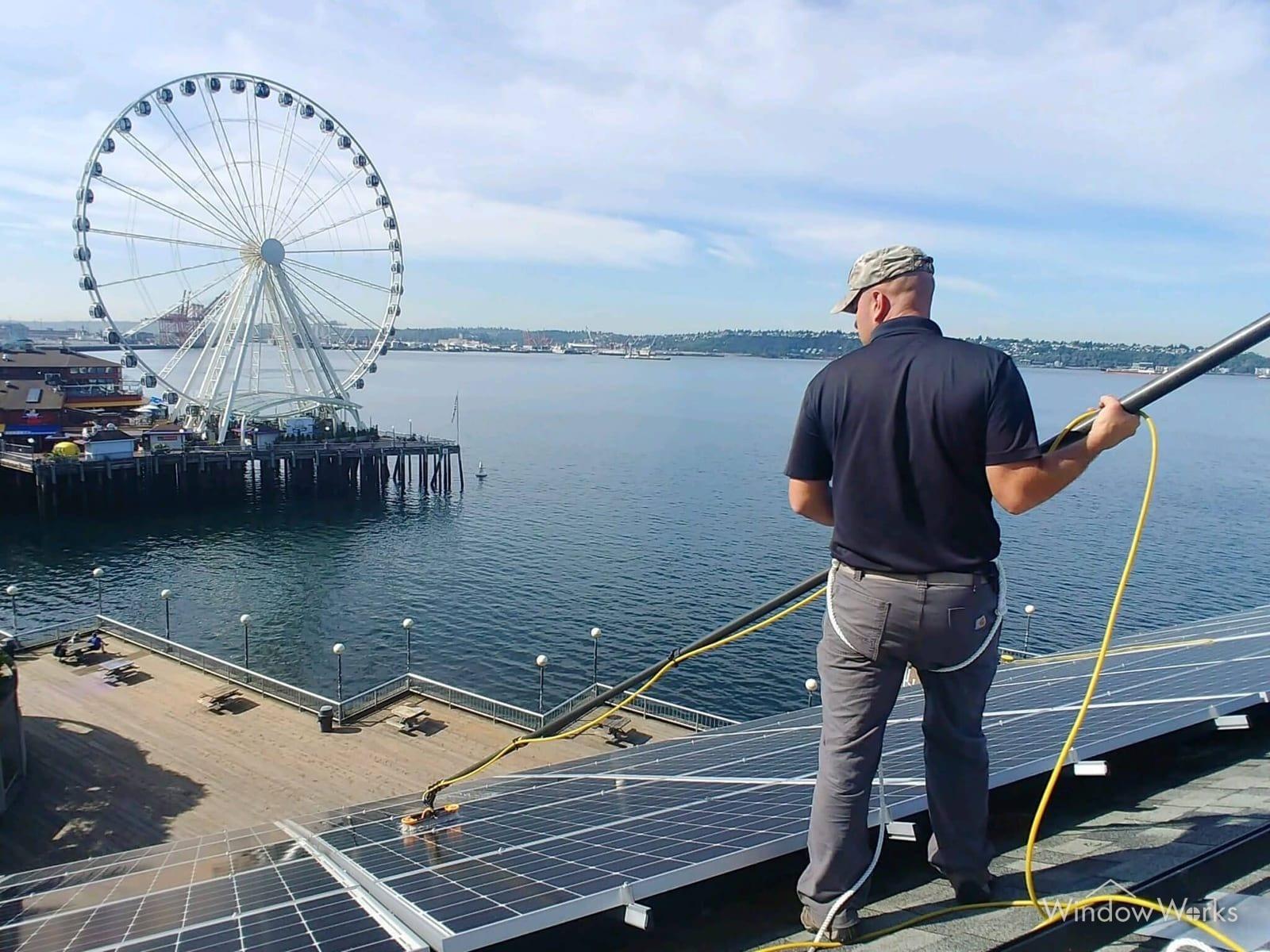
We clean panels with deionized water and a soft brush, so they dry without spots. We never use detergents, abrasives or a pressure washer on them.
What About Decks And The Air Conditioner?
Decks depend on the boards. A guide on the site of Viance, which makes the preservatives in pressure-treated lumber, says no more than 800 psi on treated wood. TimberTech allows 1,500 psi for rinsing only, and Trex rules out a pressure washer on its older lines. We wrote up what each one says in our deck article.
The air conditioner sits right against the siding, so it is worth knowing too. Trane says not to use a power washer on the condenser, because the force bends the thin metal fins. Rinse it with a garden hose from outside the cabinet.
What Is A Pressure Washer Good For?
Concrete. Driveways, walkways and patios take pressure well, and we clean them with a rotary surface cleaner in overlapping passes so the concrete comes out even, without stripes.
Even on concrete, more pressure is not always the answer. Oil and gum need hot water, rust needs an acid cleaner, and blasting harder just wears out the surface.
Can I Pressure Wash My Own House?
- Look up your siding maker's care page first. If it says no, do not do it.
- If it allows a pressure washer, use the lowest setting and a wide fan tip, hold it straight at eye level and never aim it upward.
- Keep the spray off windows, doors, vents, outlets and the air conditioner.
- Stay off the roof. The ladder is the dangerous part, and the shingle makers say no pressure anyway.
- Concrete is fine. Start with the lowest pressure that cleans it.
What Does A Soft Wash Cost?
Our house washing starts at $300 for a water-only rinse, or $600 for a full soft wash on its own. Across our 56 house washes since January 2025, most homes paid $750 to $1,150 for the house, and the one in the middle was about $900. The size of the house, the number of stories, the siding and how much growth is on it set the price.
Price your house online, or call (425) 957-7403:
Our two house wash packages, and what a wash will not take off:
How soft washing works, step by step:
What the shingle makers say in full:
About these numbers: prices are before sales tax. The job counts cover jobs we completed between January 2025 and November 2026; one job can include more than one service. The house washing range and middle job cover the house wash part of 56 of those jobs. What each maker allows comes from its own care page or guide, read in November 2026. The photos are from our own crews.
Sources
- Asphalt Roofing Manufacturers Association, "Algae & Moss Prevention and Cleaning for Asphalt Roofing Systems" (asphaltroofing.org, February 2012)
- Owens Corning Roofing, "Cleaning Asphalt Roof Shingles" (owenscorning.com, May 2026)
- James Hardie, "Frequently Asked Questions," Siding Care, and "How to Clean Siding on your House" (jameshardie.com, April 2024)
- Ply Gem, "Vinyl Siding Care & Maintenance" (plygem.com)
- Polymeric Exterior Products Association, "How to Clean Vinyl Siding" (polymericexteriors.org)
- Sto Corp., "Stucco Repair and Maintenance," No. 1.01 (stocorp.com)
- Marvin, "Window and Door Maintenance: Cleaning and Care" and "How to Clean Windows the Right Way" (marvin.com)
- Andersen Windows, "How to clean windows like a pro" (andersenwindows.com)
- REC Group, "Quick guide to cleaning: Ensuring the best performance of REC solar panels" (recgroup.com)
- Trane, "How to Clean Condenser Coils" (trane.com)
- USDA Forest Service, Forest Products Laboratory, "Finishes for Wood Decks," FinishLine (fpl.fs.fed.us, revised July 2013)
See what it would cost.
Get a free estimate in minutes, or call and talk it through with a real person.