

Diagnostic guide
What's On My Roof?
And will it come off with a roof wash?
Your roof is one of the most expensive things you own, and it lives outside in the weather year round. A roof wash extends its life, restores curb appeal, and heads off the damage an unchecked moss problem causes.
But not everything on a roof is something we can clean. Some of what looks like staining is permanent, and some of it is a roofing problem rather than a cleaning one. This sheet helps you tell which is which.
Please do not go up there to check
A wet Pacific Northwest roof is genuinely dangerous, and falls are the most common cause of serious injury in home maintenance. Everything on this sheet can be assessed from the ground with a phone camera and a little zoom.
If the roof is near the end, we will say so
We do not wash a roof that needs replacing. If we find yours has less than about three years of life left, we will tell you and point you to a roofer we trust. A wash on a roof you are about to replace is money you should keep.
How to read this: Roofing materials behave very differently, so this sheet is organized by roof type. Find yours and read that section. Every item is marked YES or NO. YES means our roof wash removes it. NO means it does not, and in most of those cases the honest answer is that you need a roofer rather than a cleaner.
Which roof do you have?
- Asphalt shingle (AGS)Overlapping rectangular tabs, sandpaper texture, most commonly gray, brown, or black
- MetalLong vertical panels with raised seams, or corrugated ribs, painted or bare
- Cedar shakeIndividual wood shingles, silvery gray when weathered
- Concrete or clay tileCurved or flat interlocking tiles, heavy, often terracotta or gray
- TPO, PVC, or rubber membraneA flat or nearly flat roof with a smooth rubbery sheet surface
Asphalt shingle
The most common roof in the Pacific Northwest, and the material where the moss problem matters most, because moss roots down between the granules and lifts the layers apart.
Moss
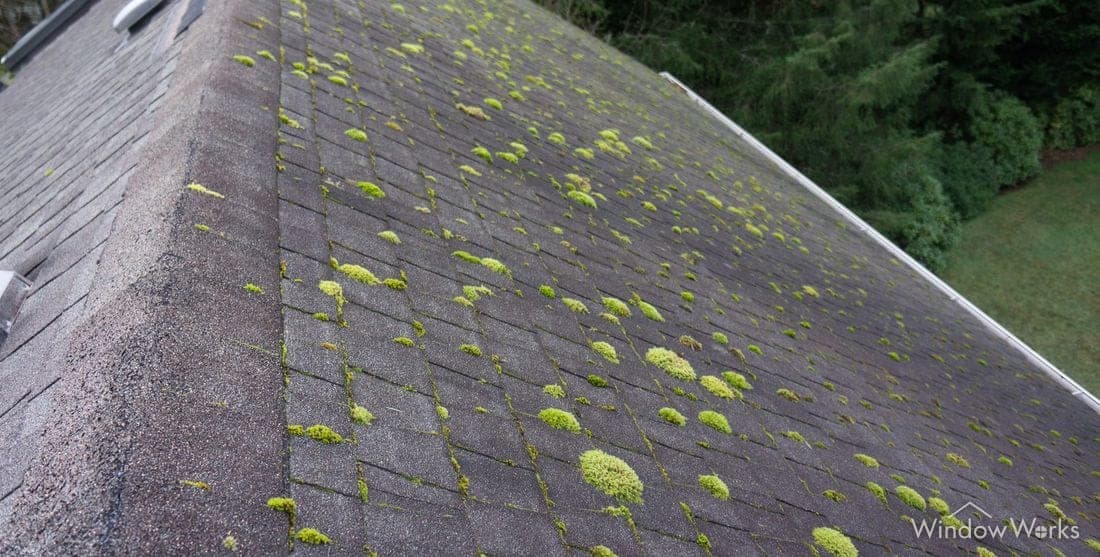
Yes. Removed by our Roof Wash
Soft green clumping growth, worst on the north side, under tree cover, and around dormers. Moss is the single most damaging biological growth an asphalt roof gets. It holds moisture against the surface, and as it thickens it lifts shingle edges and works its way between the granules.
Our wash uses sodium hypochlorite at the correct concentration for the material, which kills both the visible moss and the embedded spores. The spores are the part that matters. Treatments that only kill what you can see are why moss comes back within a season.
After the wash the moss browns and dies over the following weeks, and rain carries the dead material off. The roof keeps clearing for four to twelve weeks after we leave.
Algae, the black streaks
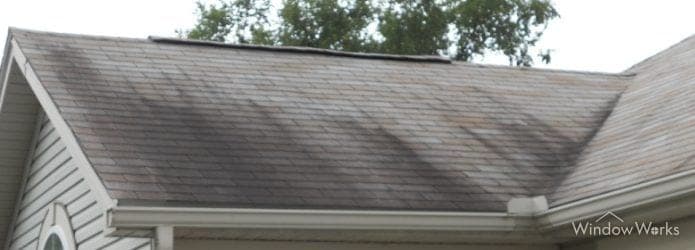
Yes. Removed by our Roof Wash
Those dark vertical streaks are caused by Gloeocapsa magma, a bacterium that grows in colonies and thrives in humid, shaded conditions. It is what people usually mean when they say their roof looks dirty.
It is largely a cosmetic problem rather than a structural one, but it is also one of the conditions insurance carriers flag when they audit properties from the air. Our wash kills the bacterium and lifts the staining, and as with moss the improvement continues over the weeks after service.
Lichen
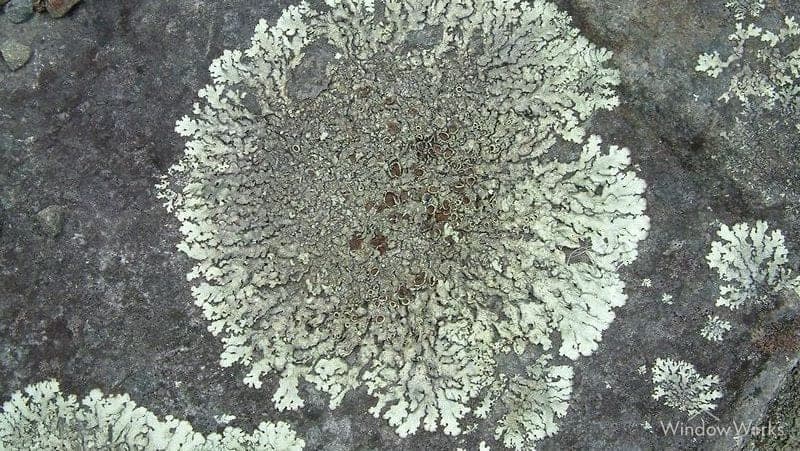
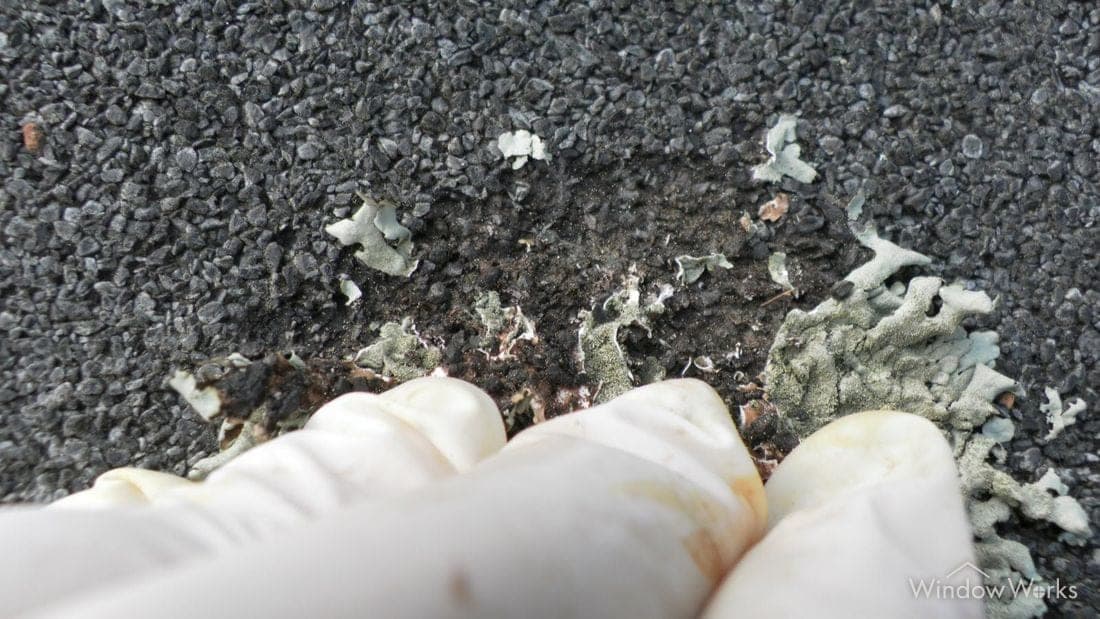
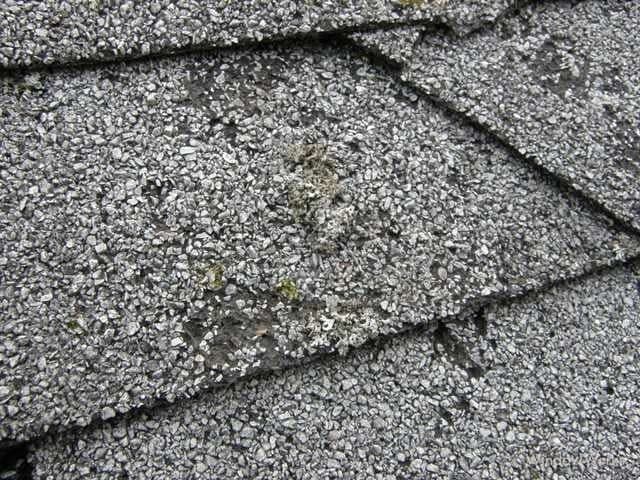
Yes. Removed by our Roof Wash
Some residual staining can remain from pigments in the lichen itself, particularly on lighter-colored shingles. This is called ghosting and it is normal. Severe infestations may need a second pass.
Crusty, flat patches in gray, green, yellow, or orange, often looking almost painted onto the shingle. Lichen is a fungus and an alga living together, which makes it considerably more aggressive and more tenacious than either one alone.
On asphalt it does something the others do not. It bonds down into the granule surface rather than sitting on top of it, which is why it resists consumer cleaners entirely and why removing it takes the right chemistry rather than more scrubbing.
Our chemistry kills it, and the dead lichen lifts off over the following weeks.
Debris: leaves, needles, branches, cones
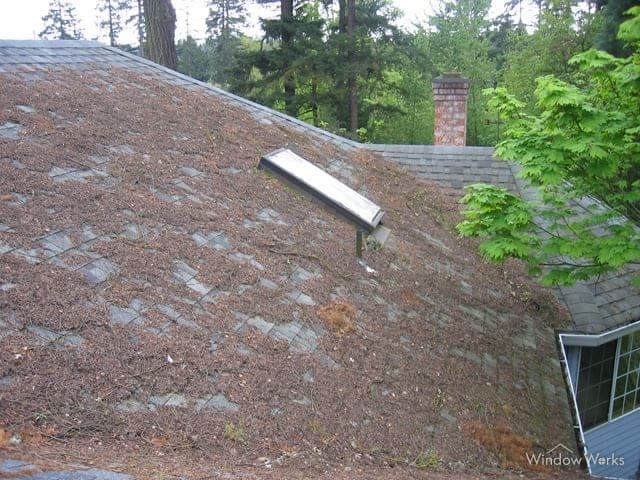
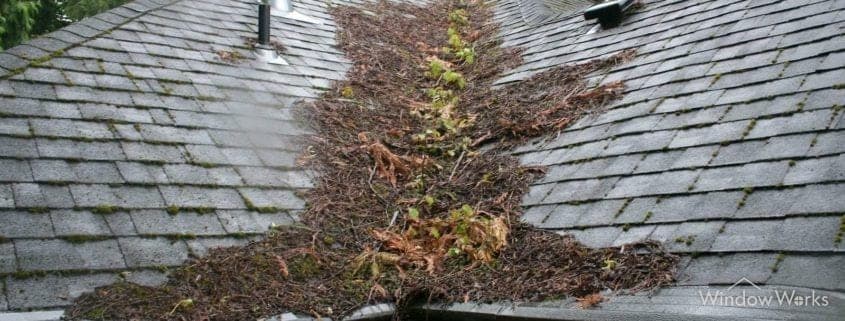
Yes. Removed by our Roof Wash
Heavy accumulation in tight valleys or behind dormers may need dedicated removal, either as part of the service or as an add-on.
Accumulation in valleys, behind chimneys, and around any obstruction. Debris is not just untidy. It holds moisture against the roof surface, which creates exactly the conditions moss needs, and it is a clog waiting to enter your gutters at the next rain.
Getting debris off the roof is the first step of every visit we do, whether it is a wash or a gutter cleaning. We clear what we can reach as part of the roof wash.
Granule Loss
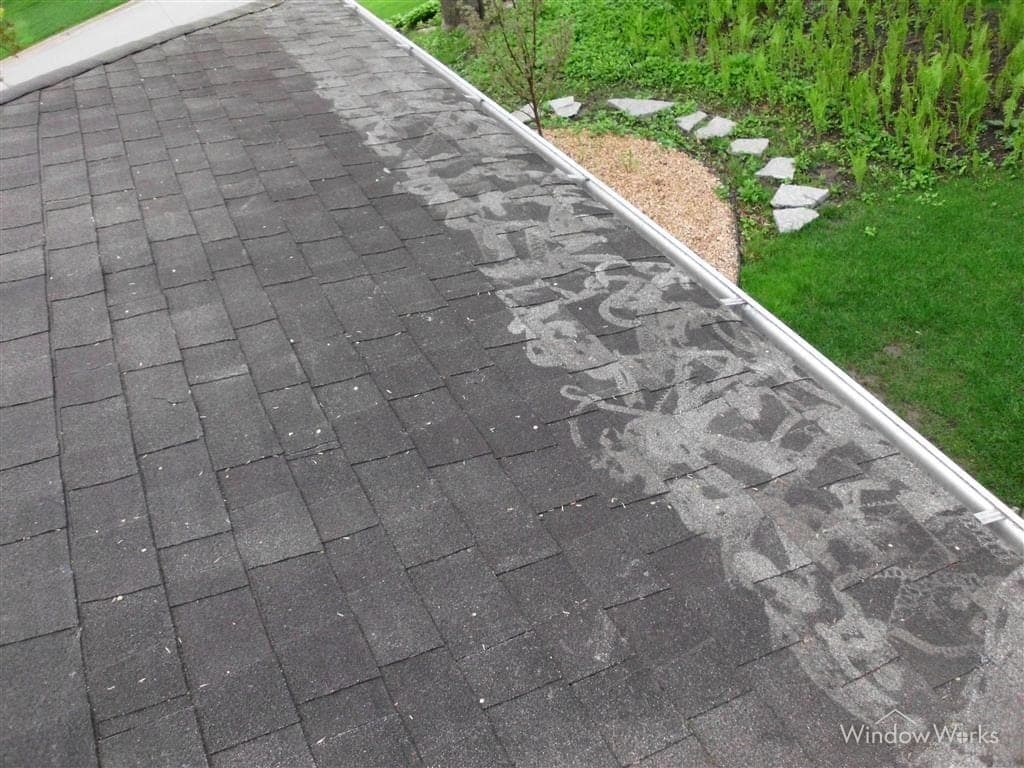
No. Not removed by a Roof Wash
The colored coating on an asphalt shingle is a layer of granules protecting the asphalt underneath from UV. When granules start washing into your gutters in volume, the roof is approaching the end of its life.
We do not restore granule loss. A roof in that condition will get cleaner with a wash, but the granules are not coming back.
The photo is what pressure washing does to an asphalt roof. It strips the granule layer in a single cleaning and takes years off the roof. This is why we never pressure wash asphalt, and why you should be wary of anyone who offers to.
Curled or Lifting Shingles
No. Not removed by a Roof Wash
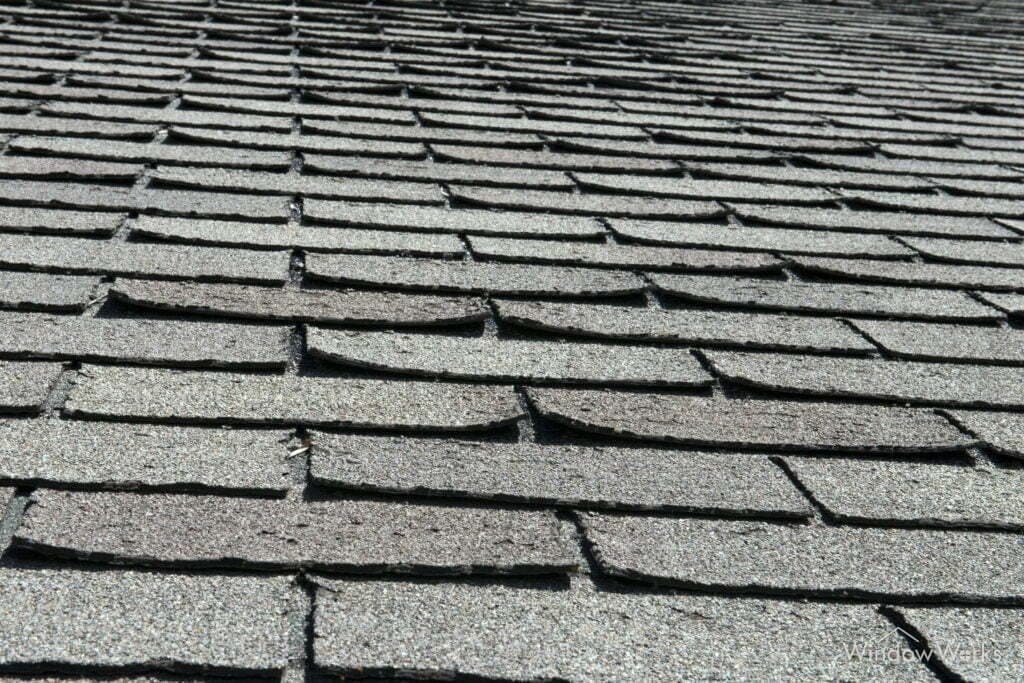
Shingle edges lifting away from the roof plane, giving the surface a wavy, unsettled look. Curling comes from age, heat cycling, moisture from below, or poor attic ventilation, and once it starts it does not reverse.
A curled roof is also more vulnerable during a wash and during any wind event, because there are now edges for water and air to get under. We can clean around it, and we will tell you what we see.
Cracked or Missing Shingles
No. Not removed by a Roof Wash
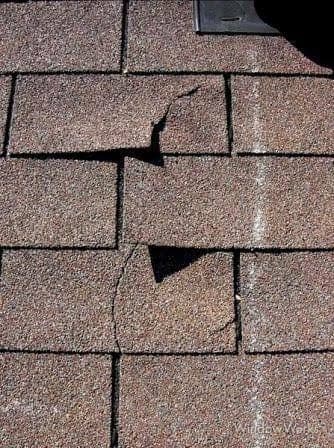
Splits, tears, and gaps where a shingle has broken or come off entirely. This is a roofing repair scope, not a cleaning scope, and it is worth acting on quickly because it is an open path for water.
We can clean around damaged sections, and we flag anything we notice during the walkaround so you know about it.
A Roof at End of Life
No. Not removed by a Roof Wash
A roof at or past its service life may still wash up clean, but the material underneath is brittle and will keep failing. Heavy granule loss, widespread curling, and cracking together are the signs.
We will tell you honestly during the walkaround if we think the roof is at end of life and if we would recommend skipping the wash. Spending money cleaning a roof you are replacing in two years is not something we want to sell you.
Not sure how bad yours is? Send a photo from the ground and we will tell you.
Get a free estimateMetal: standing seam, corrugated, painted steel, aluminum
Metal sheds water and does not hold biological growth the way asphalt does, so the problems here are different. Pollen is the big one. Where growth does appear it tends to be in the shaded panels, in the seam channels, and along the low edge where water sits longest.
Pollen
Yes. Removed by our Roof Wash
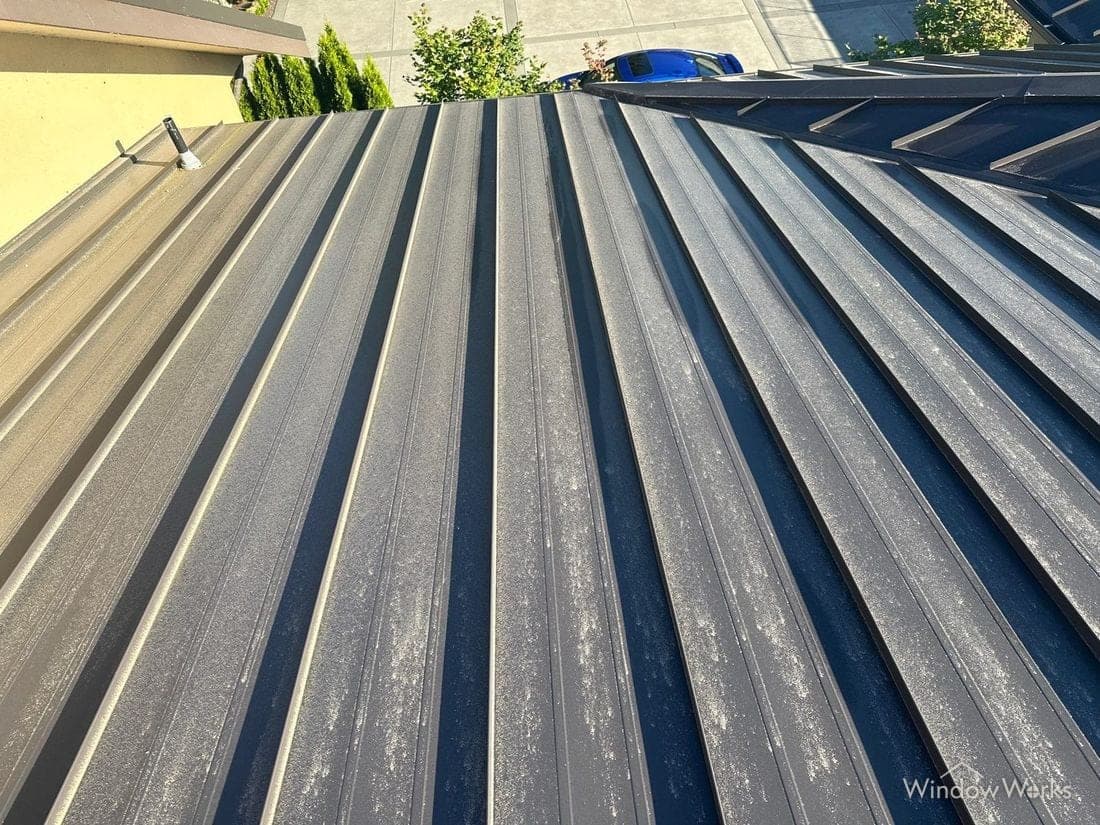
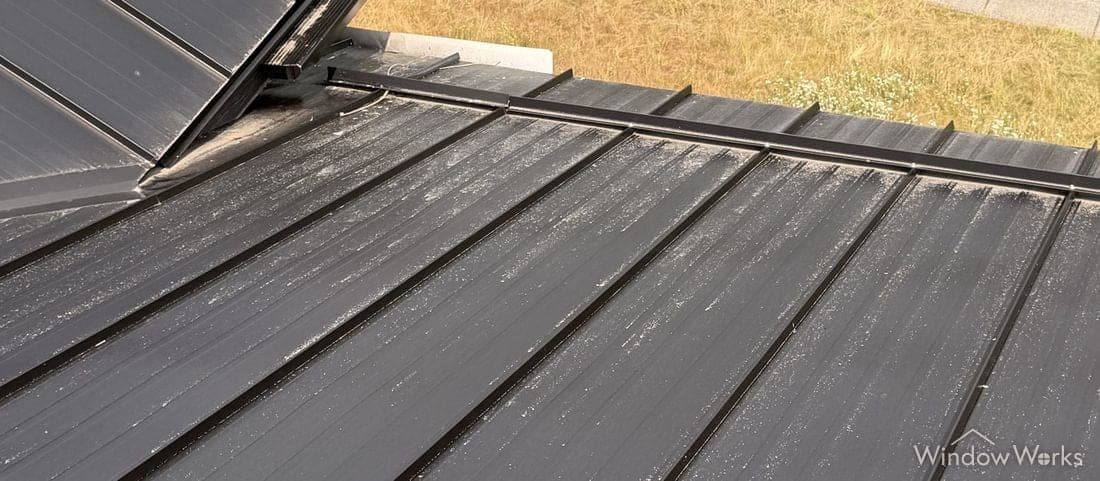
The pale speckling and yellow-brown haze that builds through spring and early summer. On a dark metal roof it is highly visible, and it is the single most common reason metal roof owners call us.
Pollen bonds to the painted surface rather than resting on it, which is why rain does not clear it and why it keeps building through the season. It washes off readily with the right solution.
Left through a wet season it becomes a food source for the algae in the next entry, so clearing it is worth doing on its own schedule rather than waiting for growth to appear.
Algae
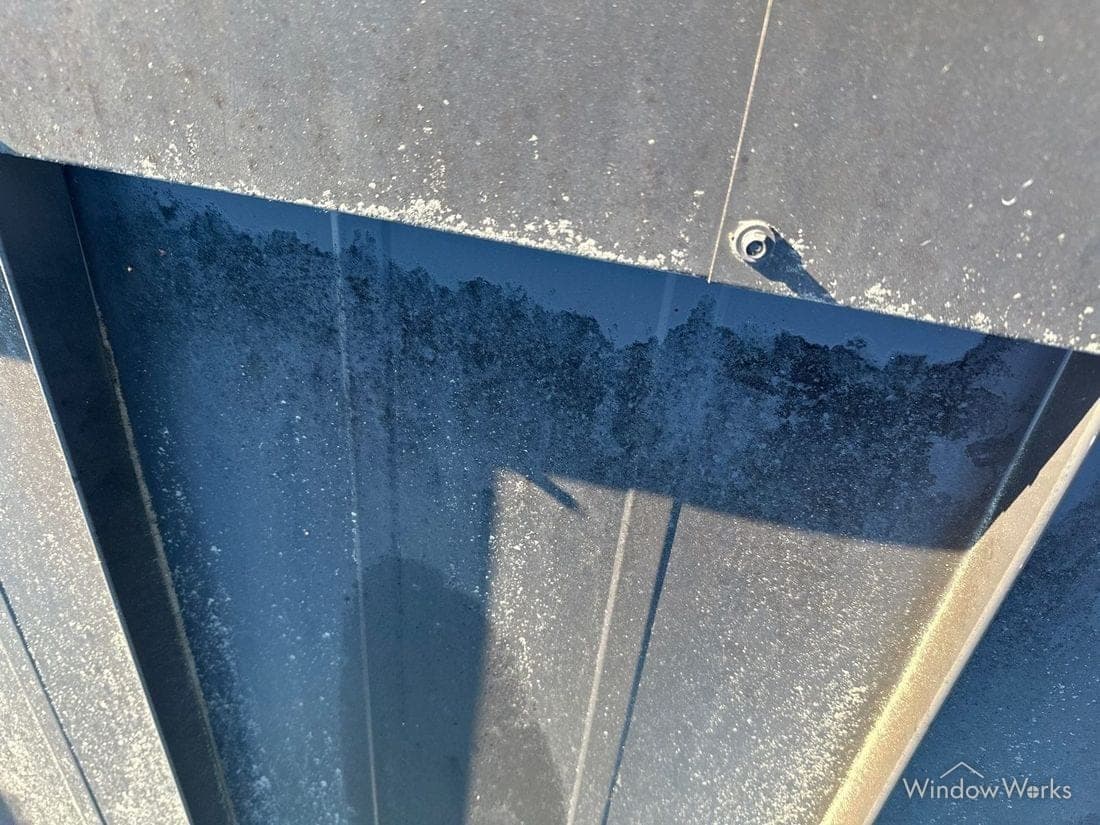
Yes. Removed by our Roof Wash
Dark green to black growth, concentrated in shaded panels, along seam channels, and at the low edge where water lingers. Less common on metal than on asphalt, but it does establish, and on a dark roof it reads as staining rather than as growth.
We use a reduced concentration on metal to protect the painted coating, with a light low-pressure rinse afterward. Metal is not tiered like our shingle service. There is one safe way to do it on this material.
Lichen
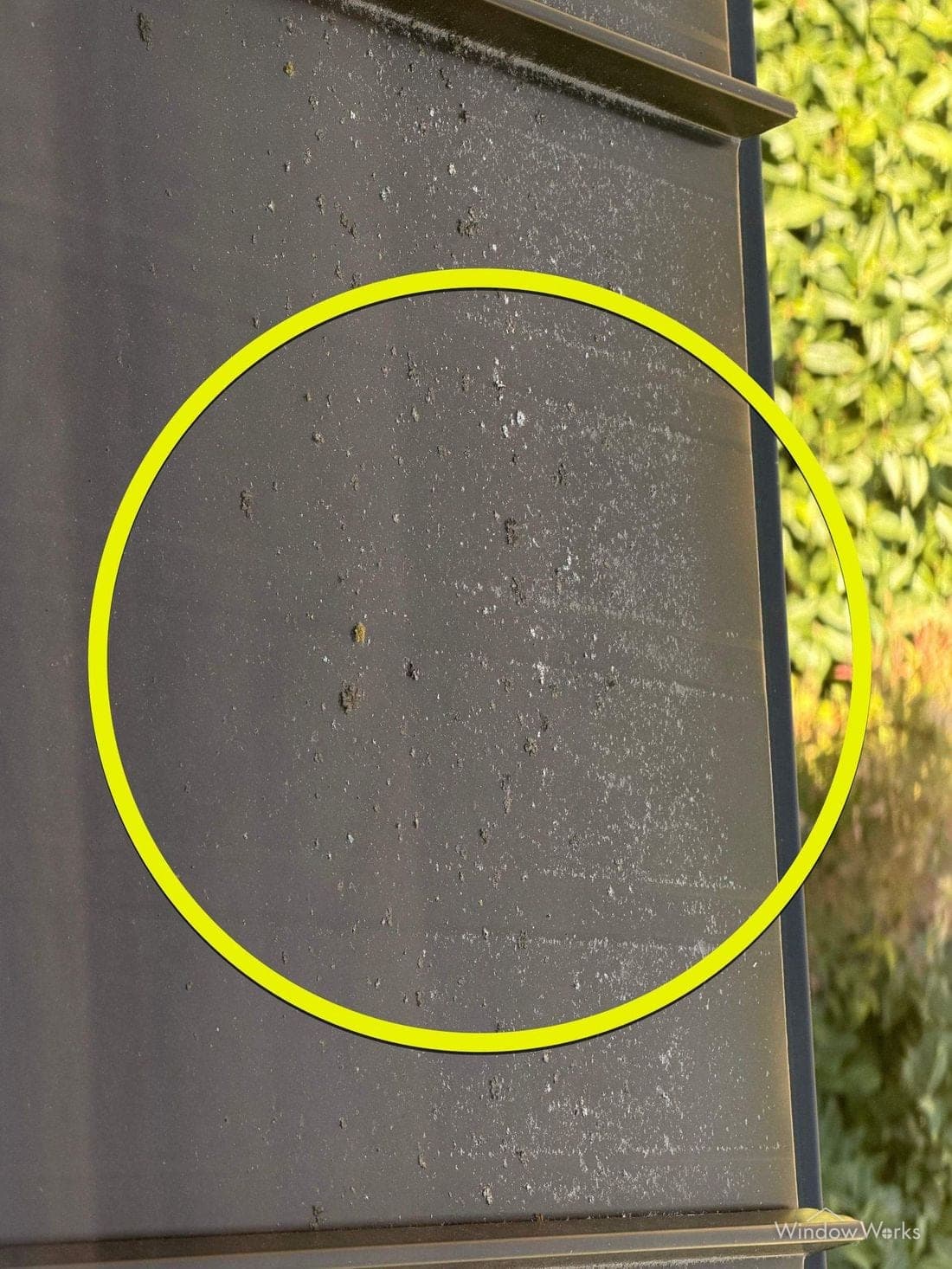
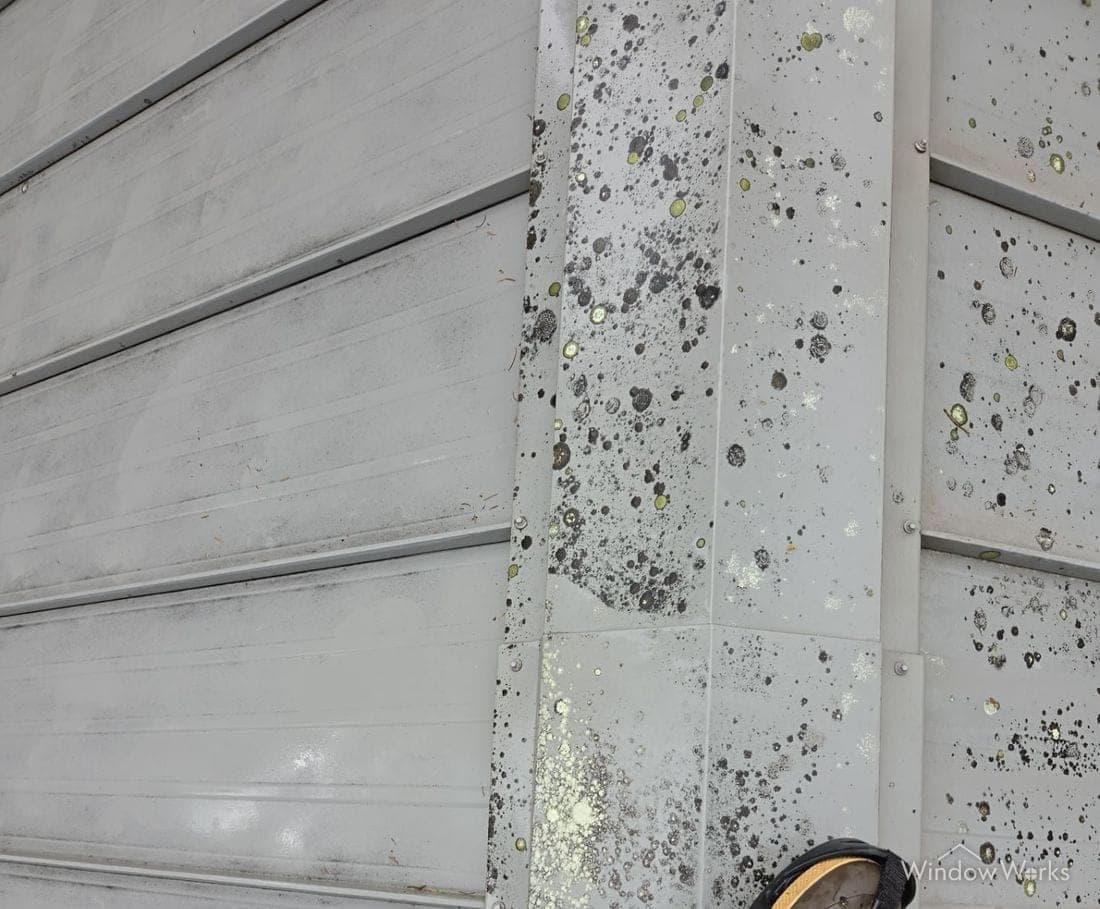
Yes. Removed by our Roof Wash
Some faint marking can remain where lichen has been established for a long time on a painted surface.
Small pale crusty spots, circled in the first photo because they are genuinely easy to miss on a dark panel until you are close. The second photo is a far heavier case on light painted metal panels. Those are wall panels rather than roof panels, but it is the same coating and the same lichen, and it shows what an established colony looks like once it has had years to spread.
It comes off with our treatment. Catching it early matters more here than on other materials, because the longer it bonds to a painted coating the more likely it is to leave a mark behind when it goes.
Surface Rust on Galvanized or Unpainted Metal
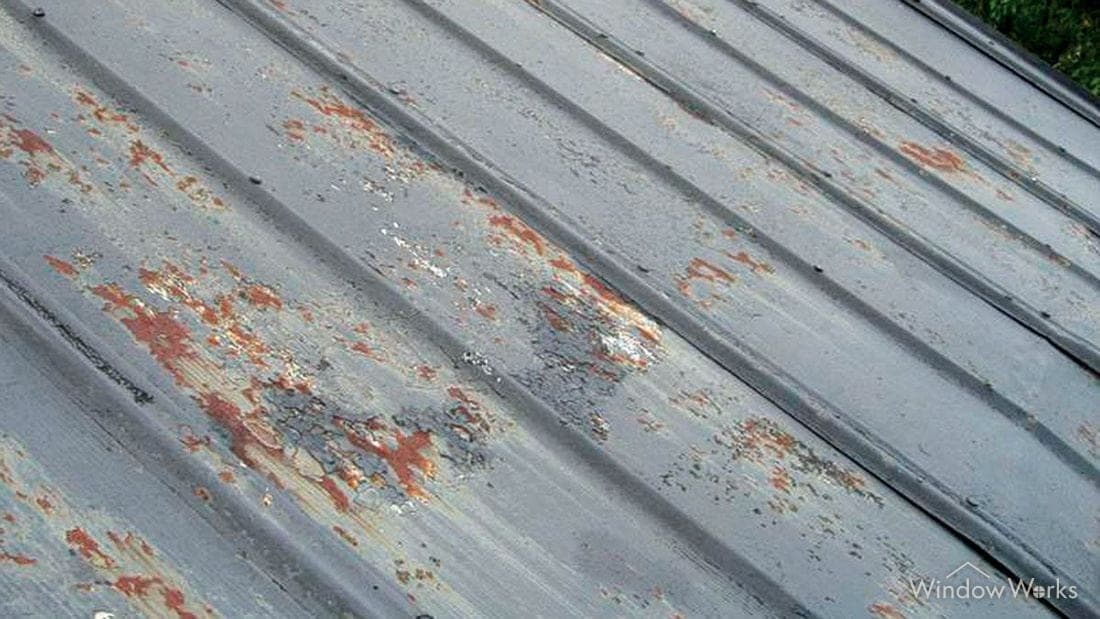
No. Not removed by a Roof Wash
Light surface rust may be removable case by case with our restoration chemistry. The corrosion behind it still needs addressing.
Orange and brown breakout across the panels, usually starting at fastener points, cut edges, and seams where the coating was broken first. Rust means the protective coating has already been compromised and bare steel is exposed to weather.
The rust itself does not come off with a normal roof wash, and washing it does not stop it. What you are seeing is the coating failing, and the corrosion underneath needs a roofer.
Oxidation and Chalking
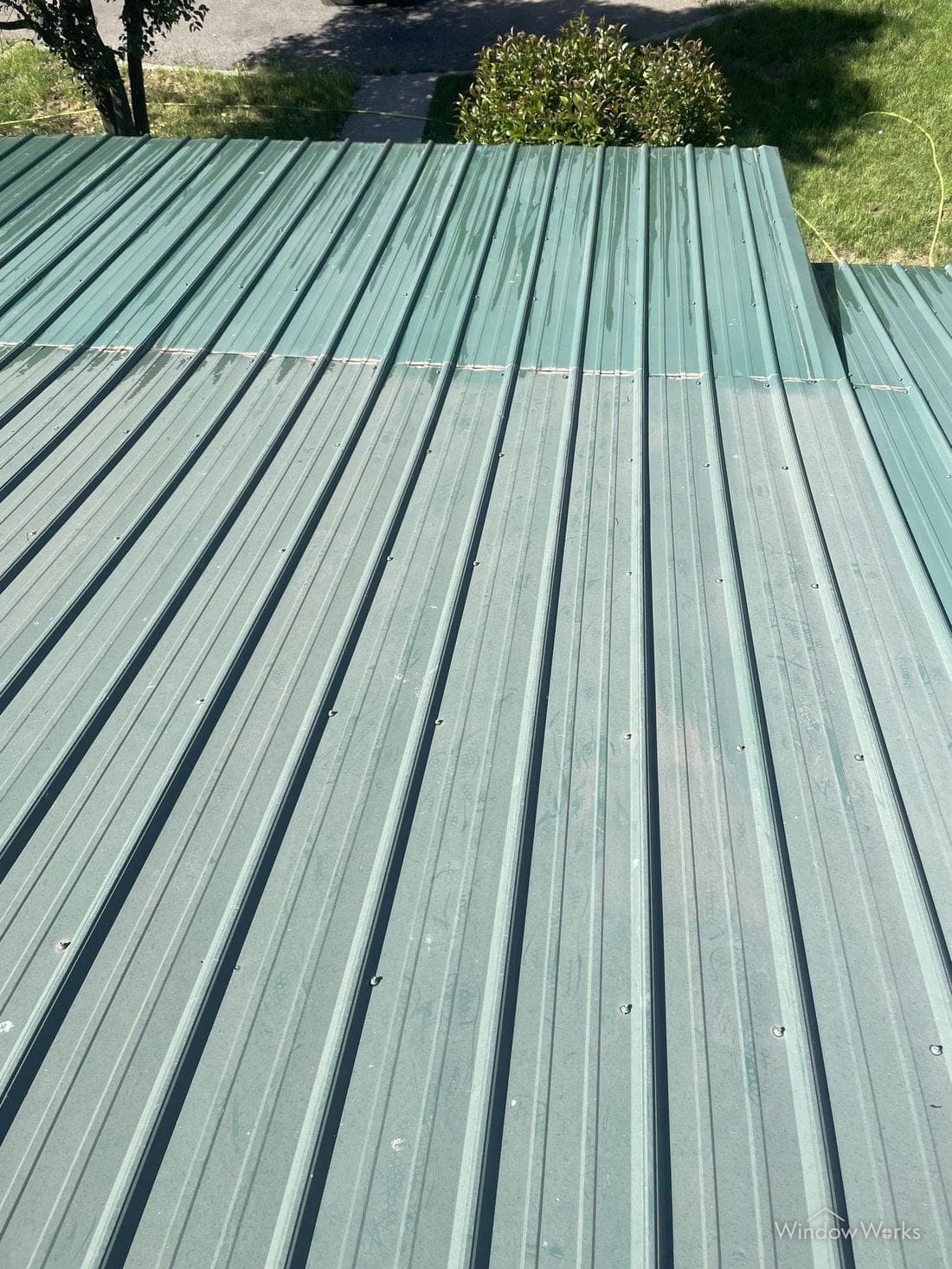
No. Not removed by a Roof Wash
Yes. Removed with our Oxidation Removal process
Oxidation removal is a separate specialty process using specialty cleaners and mechanical agitation, and it can restore a substantial amount of the original color. Results depend on how far the coating has degraded, so we quote after a test panel rather than over the phone.
A dull, washed-out, faded look across the panels. In the photo the difference is visible in a single frame: the pale, milky panels are oxidized, and the saturated green alongside them is the same roof after oxidation removal.
Oxidation is not something sitting on the surface. UV light breaks down the resins and pigment in the coating, and the degraded material migrates up as a fine chalk. Run a hand across it and that chalk comes off on your palm in the color of the roof. Dirt does not do that.
A standard roof wash cleans the surface but does not touch oxidation, and a roof can look worse after a wash because the grime that was evening out the appearance is gone.
Painted Coating Failure
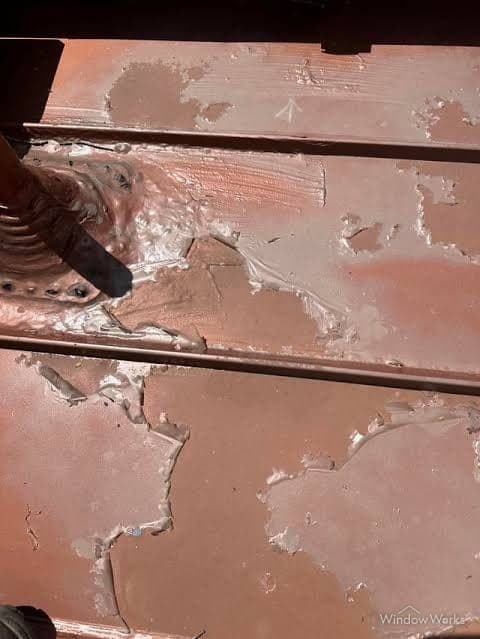
No. Not removed by a Roof Wash
Peeling, flaking, and lifting paint, past the point where oxidation is the issue. This is the coating letting go of the substrate rather than breaking down at the surface.
The distinction from oxidation matters. Oxidation is chalk you can remove. This is a coating that has already failed and needs recoating or replacement.
We can wash the roof to make it as clean as it can be, and we will be straight with you that washing a roof in this condition improves very little.
Hail Damage and Dents
No. Not removed by a Roof Wash
Dents from hail or a fallen branch are a roofing or insurance scope. Not a cleaning issue.
Not sure how bad yours is? Send a photo from the ground and we will tell you.
Get a free estimateCedar shake
Moss
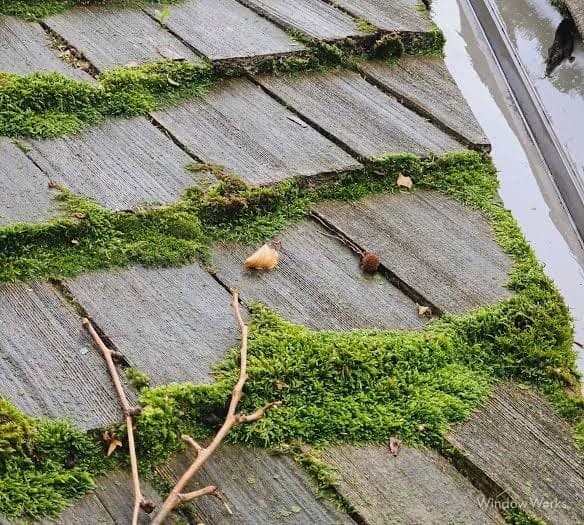
Yes. Removed by our Roof Wash
Thick green growth filling the gaps between shakes and creeping across the courses. Moss is the most damaging thing that happens to a cedar roof, and it is worse here than on any other material, because the moss holds water directly against wood that then cannot dry.
Cedar takes a lower concentration than asphalt or metal to protect the wood, with an extended dwell time to reach growth that has rooted down into the gaps.
A cedar roof wash often finishes with an oxalic acid brightener, which rebalances the surface pH and brings the natural color back rather than leaving the wood looking bleached.
Mold and Algae
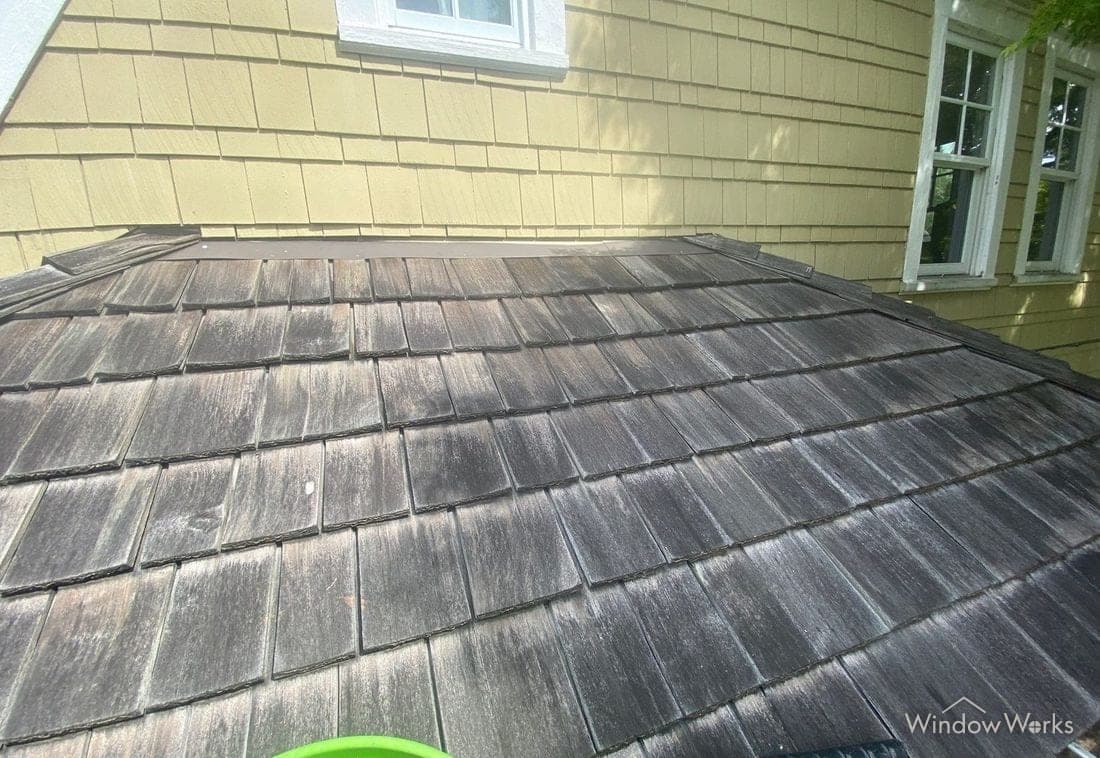
Yes. Removed by our Roof Wash
The overall darkening and gray-black cast that makes a cedar roof look old before it is. Unlike moss, algae and mold do not form clumps you can point at. They colonize the whole surface, which is why homeowners often assume the roof has simply weathered.
It is worth telling apart from genuine UV weathering, because one comes off and the other does not. If the darkening is uneven, heavier on the shaded elevations, and lighter where the sun hits, it is biological and it cleans up.
Lichen
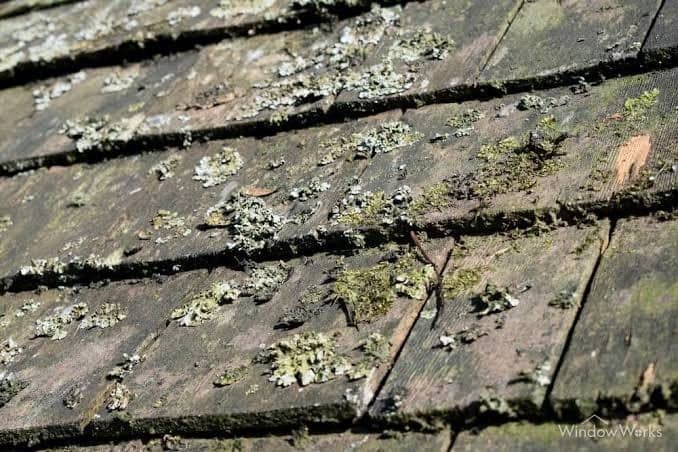
Yes. Removed by our Roof Wash
Some faint marking can remain in the grain where lichen has been established a long time.
Pale gray-green crusty patches bonded onto the shake surface, often alongside moss in the gaps. Lichen is a fungus and an alga living together, which makes it slower to establish than moss but considerably harder to remove.
On cedar it works into the grain rather than sitting on top, so our chemistry kills it and the dead material lifts over the following weeks rather than coming off on the day.
Debris
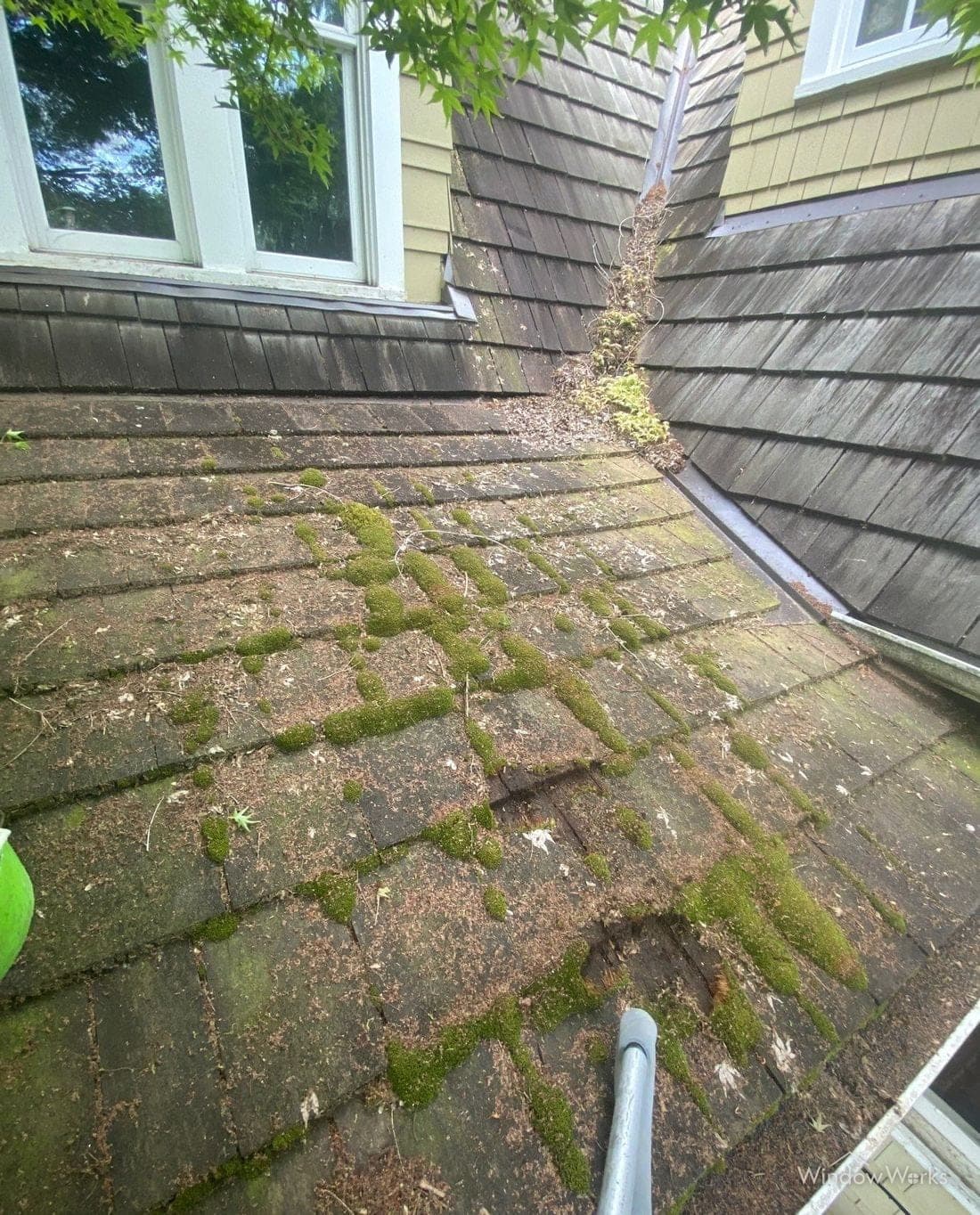
Yes. Removed by our Roof Wash
Needles, leaves, and organic matter packed between the shakes and collecting in the valleys. This matters more on cedar than on any other roof, because the debris holds moisture directly against wood and the wood cannot dry underneath it.
Debris and moss usually arrive together, as in the photo, and each one makes the other worse. Clearing it is the first step of every visit.
Rotted, Split, or Curled Shakes
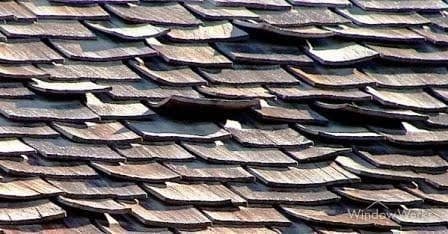
No. Not removed by a Roof Wash
Shakes that have cupped, curled at the butt, split along the grain, or gone soft at the edges, as in the photo. This is age and moisture cycling, and it does not reverse with cleaning.
Failed individual shakes are a roofing repair. We flag what we see during the walkaround so you can get them replaced before the next wet season, and we stay off sections where the shakes will not hold weight.
Not sure how bad yours is? Send a photo from the ground and we will tell you.
Get a free estimateConcrete and clay tile
Moss and Algae on Tile
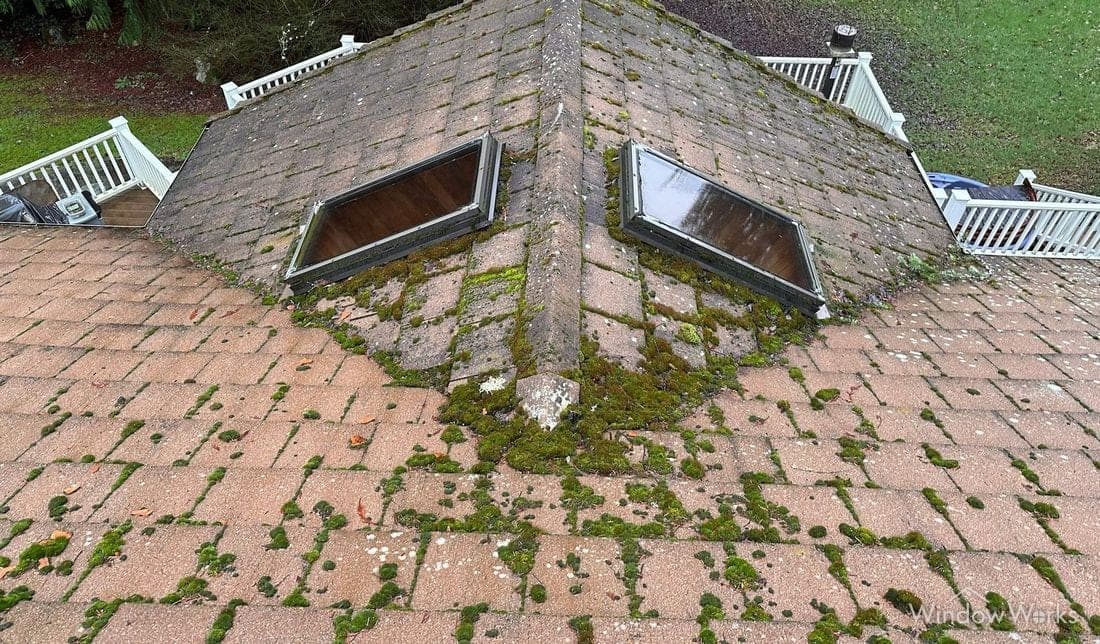
Yes. Removed by our Roof Wash
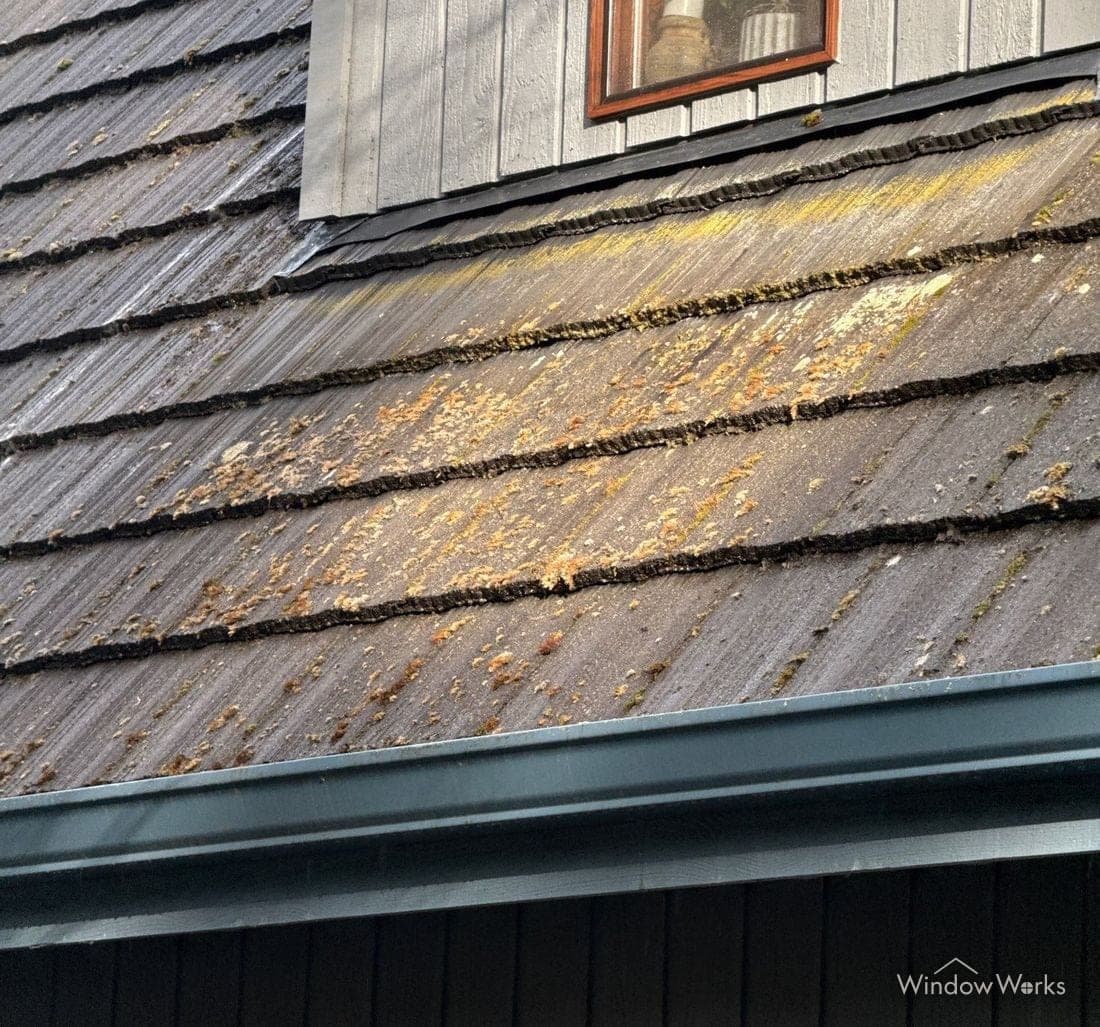
Green growth filling the joints between tiles and spreading out across the field from the shaded edges, as in the photo. Tile is porous, so it holds moisture longer than a sealed surface and gives moss an easy foothold in the channels and along the hips.
On a tile roof moss is less of a structural threat than it is on asphalt, because it cannot lift a granule layer that is not there. What it does instead is dam water in the channels and push it sideways under the courses, which is a problem for the underlayment rather than the tile.
We use an extended dwell, because the porous surface keeps the chemistry working longer. Tile generally cleans up well and the result lasts a long time.
Lichen on Tile
Yes. Removed by our Roof Wash
Pigment staining from heavy lichen can remain on lighter-colored tile. Most of it weathers off within a few months.
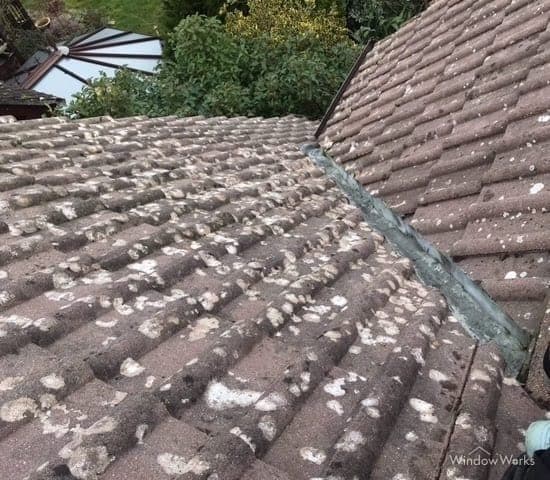
Crusty patches bonded flat onto the tile face, anywhere from bright yellow-orange to chalky gray-white. Both photos are lichen, and the color difference is only a matter of species and tile color, not severity.
Lichen is a fungus and an alga living together, which makes it slower to establish than moss and considerably harder to remove. On porous tile it grips into the surface texture rather than sitting on top of it.
Our chemistry kills it, and the dead material weathers off over the following weeks rather than coming off on the day.
Debris on Tile
Yes. Removed by our Roof Wash
Debris collects in the channels between tiles and in the valleys, where it holds water against the roof and eventually finds its way underneath. Cleared as part of the service.
Efflorescence, the White Powder on Concrete Tile
No. Not removed by a Roof Wash
Yes. Removed with our Acid Washing process
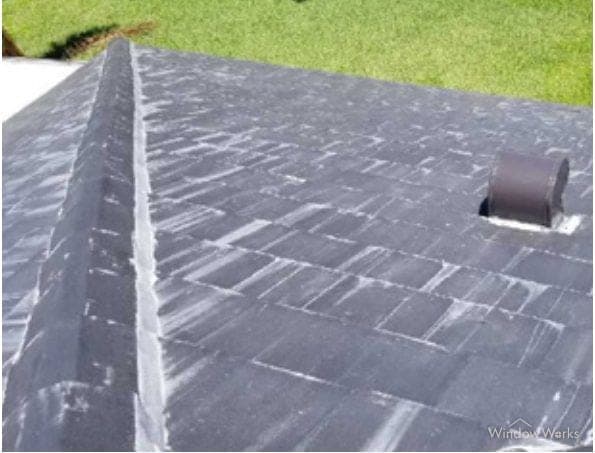
Removable with our acid washing process. Long-term prevention means addressing the moisture cycle moving through the tile, or it returns.
White powdery deposits caused by salts leaching out through the body of the tile, as in the photo. You can tell it from lichen or algae because it has no growth pattern to it. It appears as a fairly uniform bloom or as streaks following the water path, rather than as distinct patches.
It is most common on newer concrete tile, where the tile is still curing out, and it often fades on its own over a season or two.
Cracked or Broken Tiles
No. Not removed by a Roof Wash
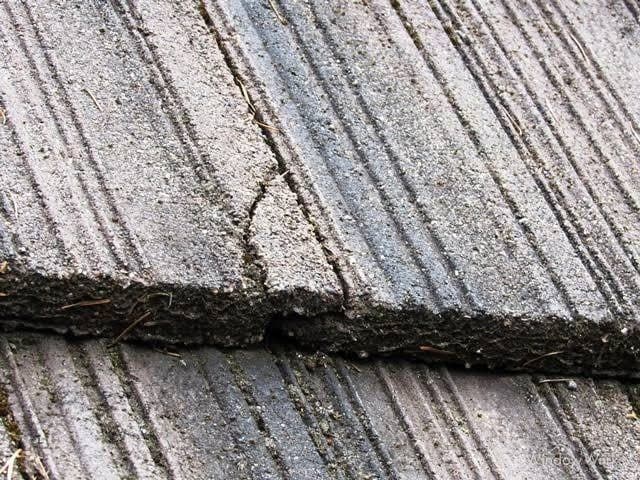
A hairline crack like the one in the photo is easy to miss from the ground and still enough to let water through to the underlayment. Cracks come from impact, age, or foot traffic in the wrong place on the tile.
This is a roofing repair, not a cleaning issue. We flag what we find and avoid walking on damaged sections.
Mortar and Underlayment Failure
No. Not removed by a Roof Wash
Failed ridge mortar, or exposed and deteriorating underlayment beneath the tile, are roofing issues. Cleaning the visible surface does not address the failure underneath.
Not sure how bad yours is? Send a photo from the ground and we will tell you.
Get a free estimateTPO, PVC, and rubber membrane
Mostly low-slope commercial roofs, though they appear on residential additions and flat sections.
Atmospheric Dirt, Grime, and Pollen
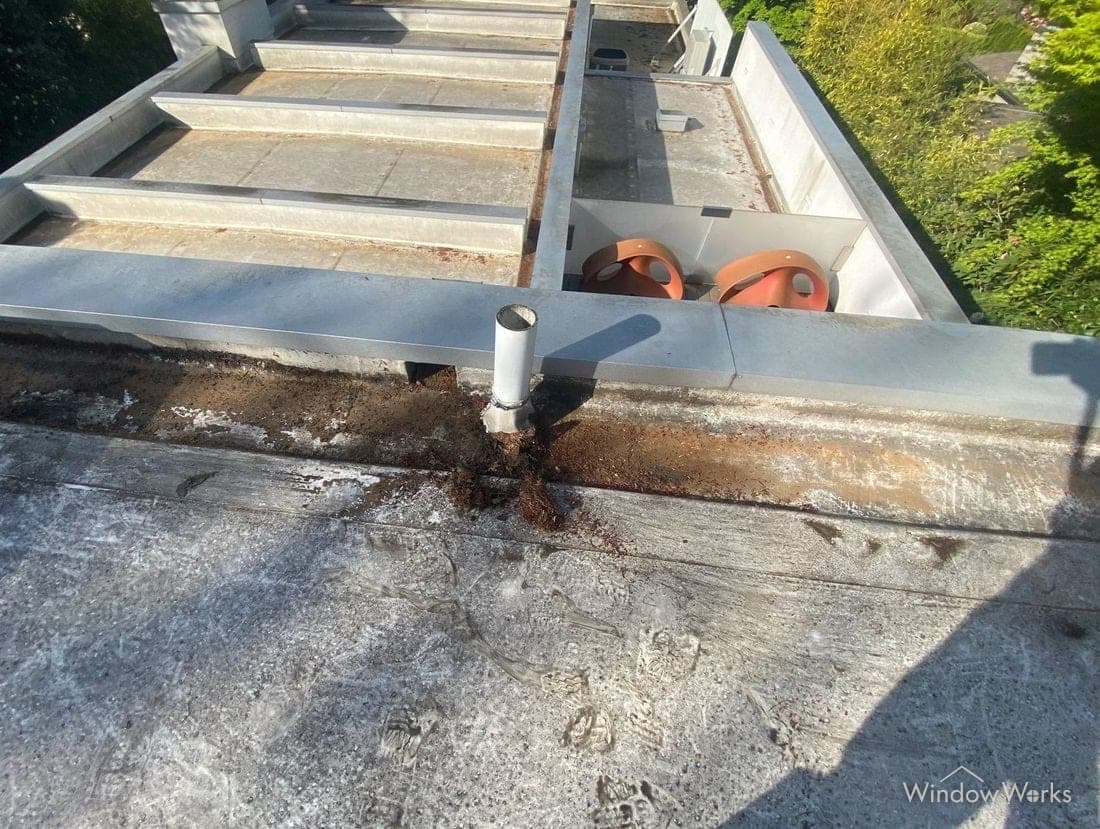
Yes. Removed by our Roof Wash
Membrane accumulates atmospheric dirt more than biological growth. It builds up worst where water concentrates, which is why the photo shows the heaviest buildup along the base of the parapet and fanning out below the overflow outlet. Foot traffic from equipment servicing tracks it across the rest of the field.
That rust-colored fan below the outlet is not rust. It is conifer pollen, washed off the roof by rain and left concentrated wherever the water ran out. In our spring it lands on every flat roof in volume, and because a membrane has nowhere to shed it, the roof holds it until something removes it.
On a reflective membrane this is not only cosmetic. A soiled white roof loses solar reflectance, which means the roof runs hotter and the building works harder to stay cool. The wash restores the original color of the membrane.
Light Algae and Mildew
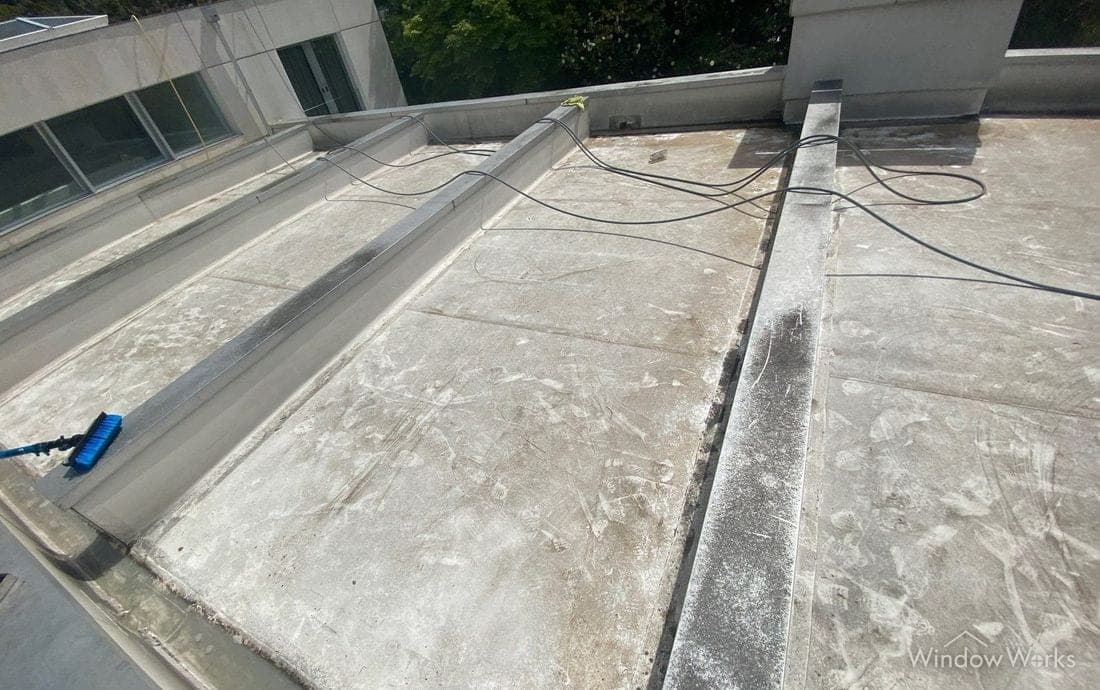
Yes. Removed by our Roof Wash
Less common than on pitched residential roofs, but present in shaded sections and anywhere water is slow to drain. The photo shows where it turns up first on a membrane roof: down in the drainage troughs and tight against the curbs and parapets, where water sits longest and the sun reaches least.
A reduced concentration handles it without risking the material.
Seam Failure, Lifted Edges, Cracked Patches
No. Not removed by a Roof Wash
Membrane damage is a roofing scope. We flag what we see.
Ponding Water Damage
No. Not removed by a Roof Wash
Where standing water has degraded the membrane in a low spot, that damage is permanent and needs a patch or replacement. Cleaning does not repair it.
UV Embrittlement
No. Not removed by a Roof Wash
Membrane that has aged past its service life goes brittle and chalky. We can clean it. We cannot restore it.
Not sure how bad yours is? Send a photo from the ground and we will tell you.
Get a free estimateThree things worth knowing about any roof wash
Why we never pressure wash a roof
Pressure washing strips granules off asphalt, drives water under metal panels and tiles, and tears up cedar fibers. The photo is a single pressure washing on an asphalt roof. Every light streak is missing granule layer, and that is permanent.
We soft wash every roof, every time: low pressure, the correct concentration of sodium hypochlorite for the material, and a surfactant so it clings long enough to work. This is the industry standard approach and the only one that protects roof life while actually cleaning.
The Asphalt Roofing Manufacturers Association advises against high-pressure washing for algae removal, and damage caused by improper maintenance is excluded from most shingle warranties. If someone offers to pressure wash your roof, that is the moment to get a different quote.
Why the roof does not look brand new the day we leave
On most roof types the visible improvement keeps going for four to twelve weeks after the wash. The chemistry kills the growth on the day of service, then rain carries the dead material off over the following weeks.
If your roof was heavily covered, the day-of result will look better but not finished. The result you are paying for is the one you see once it has finished clearing. We would rather tell you that in advance than have you standing in the driveway wondering.
What keeps the warranty active
Our roof wash on eligible roof types carries a 3-year moss-free limited warranty, and keeping it active requires one to two gutter cleanings per year performed by us. We set the number based on your tree cover at the time of the wash.
This is not an arbitrary condition. Gutters full of debris are a cool, damp environment where moss grows faster than almost anywhere else on the property, and it reinfects the roof from there. Each visit also includes a roof check, and if we find early regrowth inside the warranty period we treat it at no charge.
The single most useful thing you can do
Keep the gutters and the roof surface clear of debris. More than any other factor, that is what determines how long a roof wash result lasts and how long the roof itself lasts.
Not sure what you are looking at?
Send us a photo and we will tell you what it is.
We will identify it, tell you honestly whether it comes off with a wash or needs a specialty process, and give you a free estimate either way.
Headwaters ProWash, LLC, doing business as WindowWorks. Serving western Washington. Photographs are of conditions we have encountered in the field and are representative rather than exhaustive; your roof may present differently.